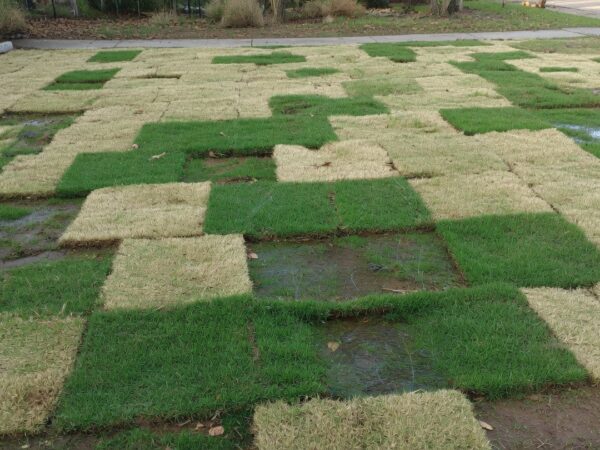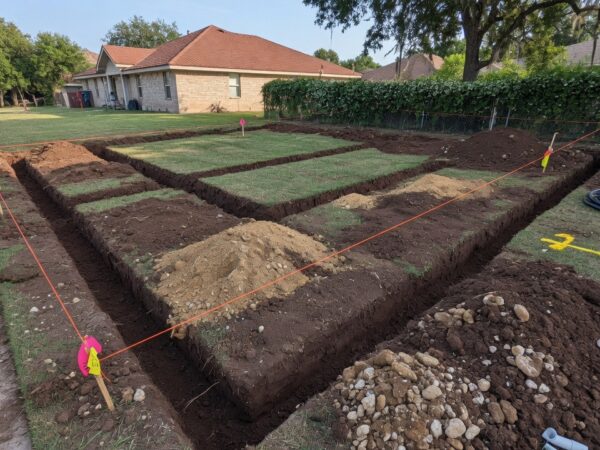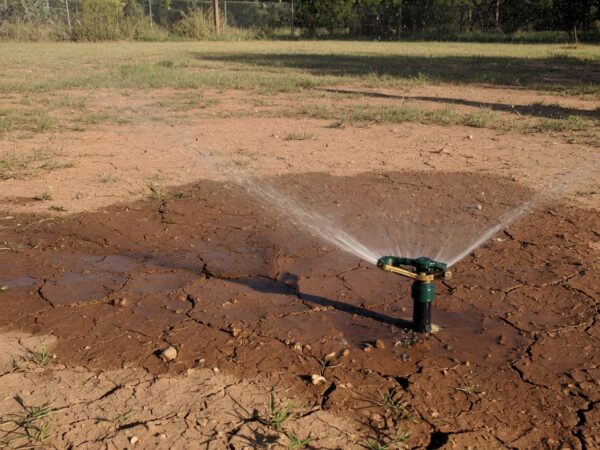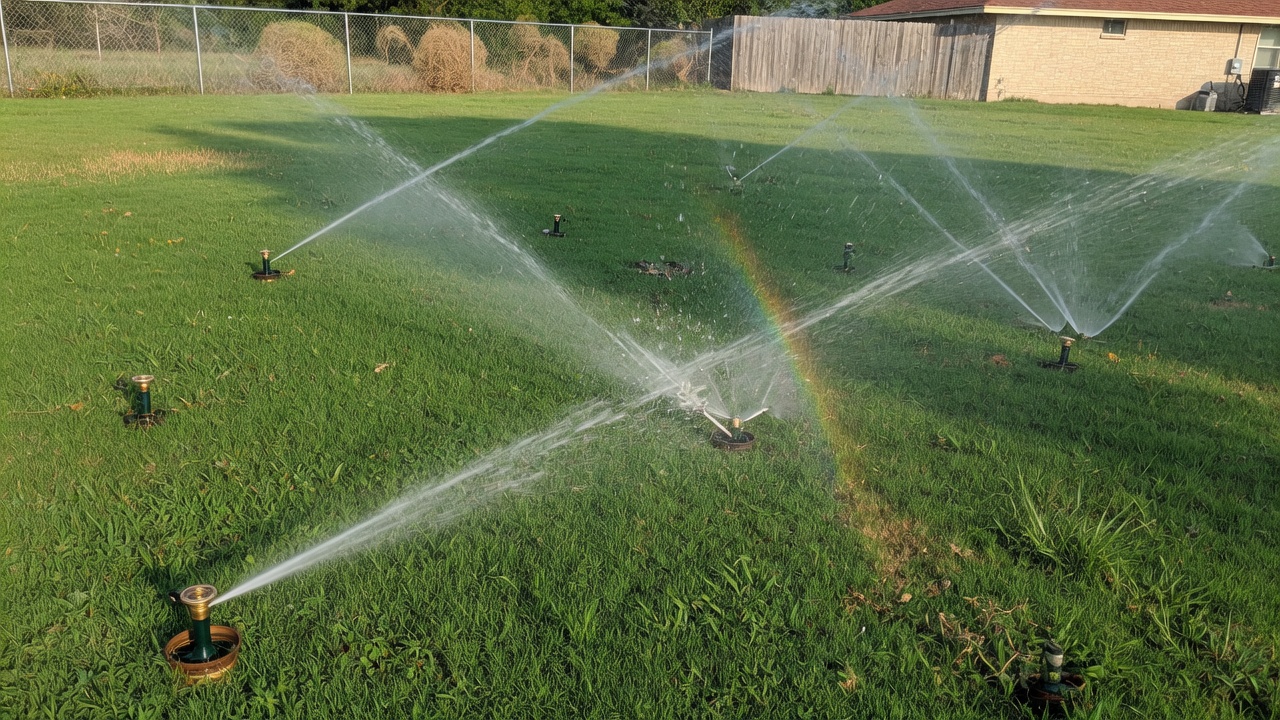
Most Deer Park lawns do not brown off in one even sheet. They brown off in a crescent between two heads. Grass beside the sprinkler stays thick, a ring a few feet out still looks acceptable, and the midpoint goes pale once July heat sits on Harris County clay. That pattern is a spacing problem long before it is a fertilizer problem. Head-to-head spacing means each head is placed so its stream reaches the next head. If the water falls short, the middle of the span gets a fraction of the depth the timer assumes, and St. Augustine does not hide that gap.
The radius molded on a nozzle is a catalog number. It assumes clean water, the pressure the nozzle was tested at, level heads, and still air. A yard along Center Street, East Boulevard, or the open lots nearer SH-225 rarely offers that. Gulf humidity makes the air feel wet. It does not put an inch of water in the root zone. A breeze off the ship channel bends a fine spray before it lands. Clay holds a puddle at the head and still leaves the midpoint dry. Head-to-head is the rule that keeps those losses from opening a dead stripe.
What the rule is actually measuring
Spacing is the distance from one head to the next. Radius is how far that head really throws on this lawn, at this pressure, on a normal afternoon. Head-to-head coverage sets those two numbers equal, or keeps spacing inside the real radius. Space a 15-foot spray at 18 feet and you have already designed a dry band. Space a rotor with a working throw of about 35 feet at 45 feet and the same band shows up, only wider and slower to notice because the streams look impressive while they are moving.
Overlap matters because of the shape of the water. A single head lays down more near the nozzle and less at the far edge. Designers count on the thin edge of one head stacking on the thin edge of the next. When the streams never meet, nothing stacks in the middle. Extra minutes soak the turf at the head, run off the clay, and still starve the gap. A rough field check is that spacing in feet should not run past the pressure in psi at the head. A spray at 25 psi should not be asked to cover a 30-foot gap.
Square rows, triangular rows, and the weak spot
Rectangular front yards usually get a square grid: heads in straight rows, the same distance down the row and between rows. That pattern is easy to fit between a sidewalk and a fence. It is also easy to stretch. In a square, the center of four heads is closer than the spacing along the side, so water from four nozzles can reach it if each head truly throws head-to-head. The failure is not a mysterious hole in the geometry. The failure is a radius that only looks long enough at dusk, when you are watching one stream and guessing.
Deeper back yards sometimes use a triangular layout, with every other row shifted. The overlap is tighter, but wind still shortens the downwind leg. Along Spencer Highway or East Boulevard, the dry spot often sits just inside the property line. Narrow parkways need a different nozzle, not a full-circle head with the arc screwed down. Side-strip nozzles throw along the strip and only a short distance across it. Mix those into a zone of ordinary quarter circles and you have left spacing for a precipitation problem, which is the subject of matched precipitation for Deer Park yards.
Pressure, clogged screens, and a throw that lies
Many fixed spray nozzles are built around 30 psi at the head. Well above that, the stream breaks into mist and the wind takes it. Well below that, droplets fall short and the plan on paper is fiction. Residential rotors are often charted higher, commonly around 40 to 50 psi depending on the model. The nozzle chart is the number that counts. A hose-bib gauge is only street pressure, not pressure at the last head. Read it at the head, then mark the throw on a breezy afternoon. The sunrise number is the best the system will ever do.
Deer Park conditions that shorten the throw
Local soil and weather punish optimistic spacing. Clay takes water slowly. A head that dumps its share in a tight circle near the nozzle builds a puddle, and the puddle runs to the sidewalk or the swale before the midpoint ever gets its turn. St. Augustine, the turf on most of these lawns, has a relatively shallow root zone and shows dry spots fast once summer evaporation picks up. The grass can look damp from humidity at 8 a.m. and still be short of water by evening.
Wind is the other constant. Lots nearer SH-225 and the open stretches toward La Porte and the ship channel see a stronger afternoon breeze than a sheltered backyard in Parkwood. That breeze does not have to be a storm. A steady push is enough to move a misting spray off a 15-foot radius and onto the street. Occasional freezes matter too. A cracked head or a split riser after a cold night shortens throw on one side only, and the dry crescent shows up weeks later when someone notices the color change. New sod makes the same spacing error look worse, because there is no old root system bridging the gap. If a new lawn is striping between heads, the layout needs a look before the sod is blamed. The follow-up is uneven coverage on new sod.
Trees change the plan without anyone touching a pipe. A head that cleared a sapling now hits a trunk, and the grass past that trunk only gets drip from the bark. Spacing has to be redesigned around the canopy.
Spacing checklist before you add a head
- Run the zone on a normal breezy afternoon and mark where water actually lands, not where the nozzle label says it should.
- Measure the distance between heads in the dry crescent and compare it with that marked throw.
- Check that every head on the zone stands straight and pops clear of the St. Augustine, not into a mat of grass.
- Clean the screen and the nozzle, then mark the throw again. Grit often masquerades as a spacing mistake.
- Read pressure at a head on that zone. If sprays are far from their design pressure, fix pressure before you cut in new fittings.
- Confirm the nozzles in one zone are a matched family. A random mix makes spacing look wrong when the real issue is depth.
- If the shortfall is only downwind, closer spacing or a lower-trajectory nozzle beats more minutes.
- Water that only reaches the next head by bouncing off a fence is not coverage.
- Write the measurements down. A later sprinkler repair goes faster when the dry spot is a number, not a memory.
When the fix is a nozzle, and when it is pipe
Sometimes the heads are already close enough and the throw is short because of a clog, a sunken body, or pressure. That is repair work: raise the head, clean it, replace a broken nozzle with one whose real radius fits the span, and balance the zone. Sometimes the heads were set too far apart on day one, or a patio, a new bed, or a grown tree ate the overlap. Those yards need another head, a moved head, or a switch from sprays to a nozzle family that can hold a tighter pattern in wind. That is sprinkler installation work, even if most of the old pipe stays.
Do not paper over a spacing gap with a longer run time. On Deer Park clay the extra water leaves the lawn. It does not sneak sideways through the soil to the dry crescent in any useful way. Fix the geometry, then set the minutes to the precipitation rate you actually have. If you want that measured instead of guessed, call Deer Park Sprinkler Repair at (281) 764-7088. Have the zone number and the rough distance between the heads ready. The throw you can see is only half of the design. The distance you can measure is the other half.