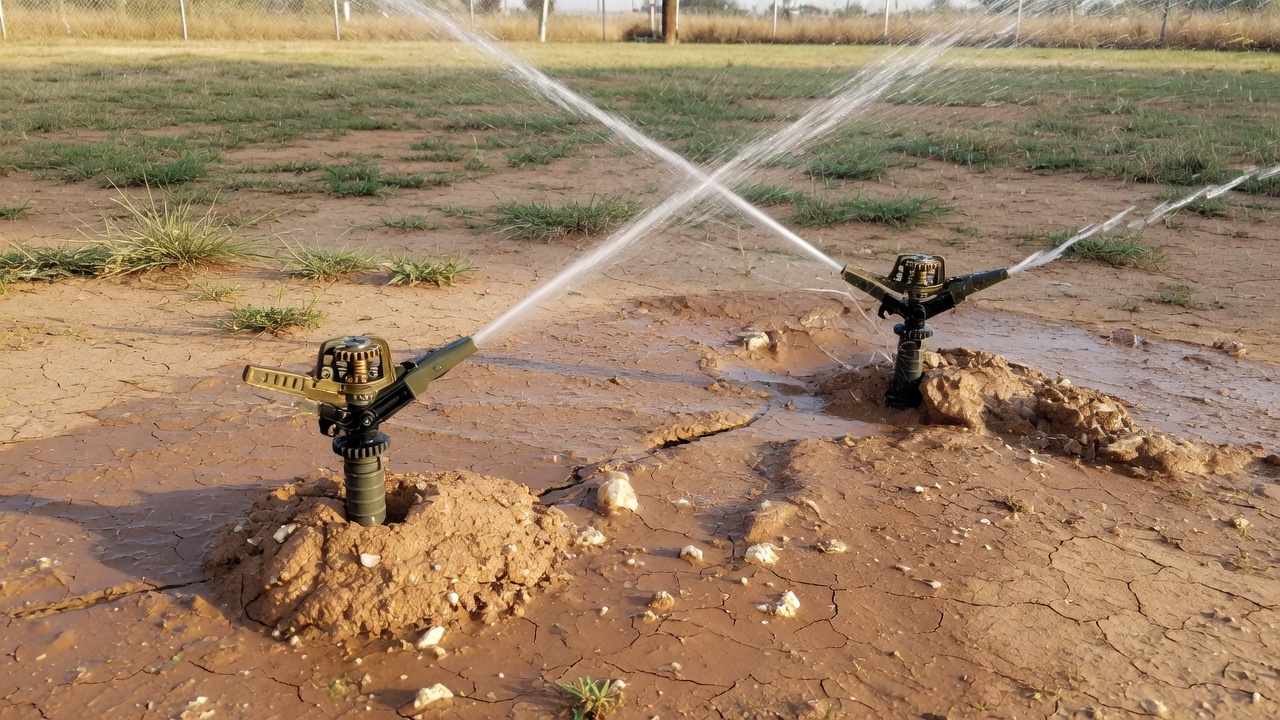
Stand at the corner of a Deer Park lot while two zones overlap at the edge of the turf and you can see the argument without reading a catalog. One rotor lays down a steady, slightly slower stream and walks its arc without drama. The other flings a heavier finger of water that slaps the driveway, stalls for a second at the end of the arc, and leaves a shine on the clay before the grass ever looks watered. Both heads are “rotors.” They are not doing the same job. On St. Augustine over Gulf Coast clay, the difference is not brand loyalty. It is how fast water arrives compared with how fast this soil will take it.
Hunter and Rain Bird both build the gear-driven rotors that cover most residential lawns around here. Hunter’s PGP family and Rain Bird’s 5000 family are the ones you will actually find in a valve box neighborhood, along with newer variants that adjust arc and radius in the same general way. They are interchangeable only in the loose sense that each can cover a medium lawn area from a pop-up body. They are not interchangeable at the nozzle. The nozzle is the part that decides the gallons and the precipitation rate. Put the wrong one on a Deer Park zone and the brand printed on the cap will not save the lawn.
What you are actually comparing
A rotor lays water down in a moving band. A spray dumps it in a constant fan, often well above an inch an hour. A matched rotor is often closer to half an inch an hour. Clay that seals under a spray will often still accept the slower rotor if you cycle it. The brand does not change that. The nozzle and the spacing do.
Both the Hunter PGP family and the Rain Bird 5000 family let you set the arc and trim the radius with a reduction screw. That screw is not a way to save water. Choking it distorts the pattern. If the head reaches the street, use a shorter nozzle or move the head. Grit that stalls a rotor is maintenance, not a reason to switch brands mid-zone.
Nozzles do not mix just because the heads pop up
Each manufacturer publishes a nozzle tree with flow and radius at a given pressure. Those charts are the comparison that matters. A Hunter nozzle that passes two gallons a minute and a Rain Bird nozzle that passes four, sitting on the same zone because both heads were “rotors,” will not water evenly. The thirstier nozzle spends the zone’s available flow. The lighter nozzle under-throws. The clay under the heavy nozzle seals and sheds water toward the sidewalk on East Boulevard. The clay under the light nozzle never gets the inch the St. Augustine needed that week. The timer cannot referee this. It only knows minutes.
Mixing brands works only when the precipitation rates match. Garage leftovers rarely do. Replace a failed rotor with the same brand and nozzle number. Converting the whole zone is a project, because every head has to be re-nozzled. Sprays and rotors on one valve are worse: the spray section floods and the rotor section starves. A multi-stream nozzle for a smaller area is a different tool, covered in MP Rotator nozzles and clay runoff, and it does not belong beside a standard spray.
Arc, spacing, and the driveway problem
Corner lots and long parkway strips along Spencer Highway punish a rotor that was left at the factory arc. A full-circle rotor in a corner throws three-quarters of its water onto concrete, the neighbor’s fence, or the street. Both Hunter and Rain Bird heads are designed so you can pull the riser up and set a left stop and a right stop. Do that while the zone is running so you can see the stream hit grass, not while the head is dry and you are guessing. Set the stop a few degrees inside the hardscape. Wind in an open Deer Park afternoon will still carry some water. A head aimed at the curb will carry a lot.
Head-to-head coverage, where one rotor’s stream reaches the next head, is what keeps the middle green. Clay makes a wide gap obvious: the rotors wet rings around themselves and the center goes hard. If no nozzle from either brand can close that gap at your pressure, add a head. Shape comes before brand. The longer guide is choosing the right sprinkler heads.
How Deer Park clay treats a rotor that applies water too fast
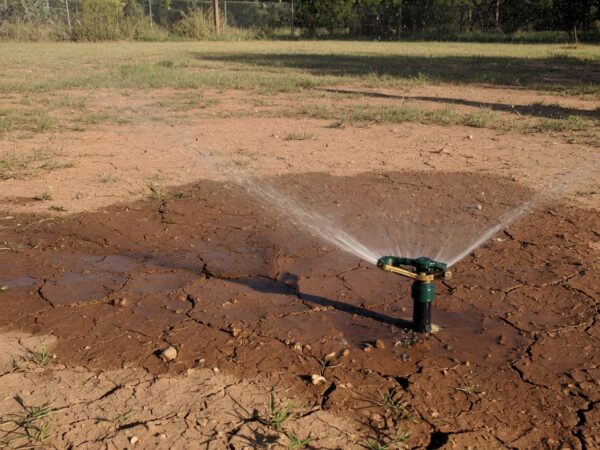
Soils here often take water slowly, then seal. A rotor is the better default for a large front lawn precisely because it can be gentler than a spray, but “rotor” is not a magic setting. A large nozzle, close spacing, and high pressure can push a rotor’s precipitation rate up until it behaves like the spray you were trying to avoid. You will see the shine. Water sits on the surface, finds the tire track or the sidewalk, and leaves the root zone short. The St. Augustine looks watered because it is wet on top. A screwdriver test halfway between heads, an hour after the cycle, tells you whether any of that water went down.
Cycle and soak either brand. Two or three shorter runs, with the sheen gone between them, beat one long cycle that ends in the gutter. That is true in Parkwood, Spencerview, and on the flatter lots near the San Jacinto College area. A rotor with a worn gear or a grit-packed nozzle is no longer gentle. It drills one wedge. Repair that head before you blame the soil.
A rotor zone matched in May becomes a runoff machine in August if the minutes doubled. Humidity does not make Deer Park clay infiltrate faster. If the gutter runs during the zone, the brand is not the problem. The rate and the schedule are.
What to match when you replace one rotor
- Read the brand and the model on the cap of a working neighbor head, not only the failed one. Match that family if the rest of the zone is healthy.
- Read the nozzle number. Replace like for like unless you have a reason, written down, to change the precipitation of the whole zone together.
- Set the arc while the zone runs so the stream stops on grass, short of the sidewalk, the fence, and the street.
- Leave the radius reduction screw open unless a light trim is truly needed. Do not use it as a shutoff.
- Check that the new head sits at grade. A rotor in a clay pocket sprays the rim and fills the hole.
- After the repair, run two short cycles instead of one long one and look for sheen and gutter flow before you add minutes.
- Do not add a spray nozzle “to fill a corner” on a rotor zone. Add a properly nozzled rotor or rethink the zone.
If every rotor on the zone is a different generation, with nozzles you cannot identify, pick one family and re-nozzle the station in one visit. A mixed fleet is how you get the corner-lot scene from the first paragraph: one head slapping the driveway, one head doing the job, and a water bill that reflects the worse of the two. Keep the spare nozzles in a bag labeled with the zone number. The next repair goes faster, and you will not “upgrade” a single head into a mismatch.
When a rotor is the wrong tool entirely
Narrow side yards and parking strips are a poor place for a standard rotor. The radius is still too long. Those areas want sprays or a short multi-stream nozzle so clay can keep up. Open St. Augustine with head-to-head spacing is where a PGP-style or 5000-style rotor earns its place. The decision is the shape of the yard, not the store aisle.
If rotors break every season because they sit too low, or the zone runs off no matter the brand, the layout is the project. That is sprinkler installation: spacing, pipe, and nozzle family chosen together. One stalled or cracked head is sprinkler repair, and the replacement should match the zone, not a different nozzle tree. Call (281) 764-7088 and say whether one head failed or the whole zone puddles.