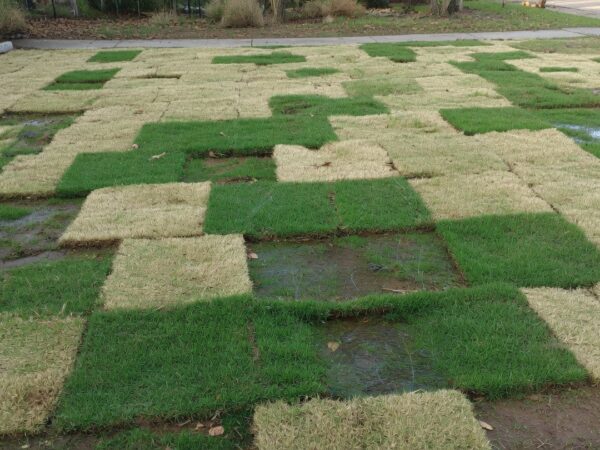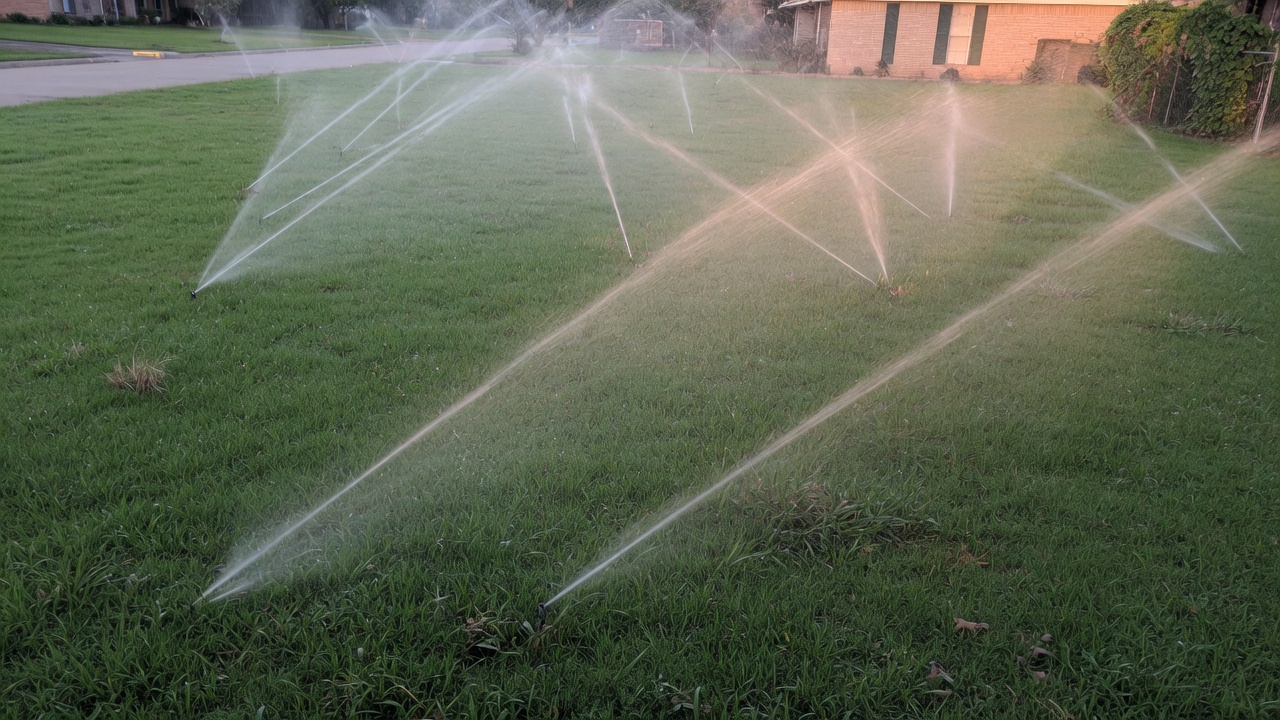
A Deer Park zone can run the “right” number of minutes and still fail in two directions at once. The corner by the driveway turns to mud. The middle of the front lawn goes dull. The timer is not the villain. The nozzles are putting water down at different speeds, and one runtime cannot serve both speeds. That mismatch is a precipitation-rate problem. Matched precipitation means every head on a zone applies about the same depth of water per hour, so the minutes you choose actually mean something.
The usual cause is a nozzle swap. A broken quarter-circle gets replaced with whatever was in the garage. The threads fit. The flow does not. On Harris County clay, the extra water has nowhere to go but across the sidewalk.
What precipitation rate is
Precipitation rate is depth over time, in inches per hour, not gallons and not “it looks wet.” A nozzle that flows more gallons is not automatically wetter on the grass. A full-circle head spreads those gallons over a whole circle. A quarter-circle head spreads its gallons over a quarter of that circle. If both nozzles flow the same gallons per minute, the corner gets about four times the depth. The fix is a smaller nozzle on the quarter, roughly a quarter of the full-circle flow when the radius is the same. A half-circle needs about half the flow. Manufacturers sell those as matched families for a reason.
You can check the idea with the standard conversion. Inches per hour are about 96.3 times gallons per minute, divided by the square feet that head covers. Double the flow on the same area and you double the depth. Cut the area to a quarter and keep the flow the same, and you quadruple the depth. The arithmetic is why a box of identical nozzles is the wrong repair for a zone that has corners, edges, and a full circle in the middle of the yard.
Charts also show two precipitation columns for the same nozzle, one for square spacing and one for triangular spacing. The nozzle did not change. The ground area assigned to each head changed. Read the column that matches how the heads are actually laid out. Spacing and rate are partners. If the heads do not reach each other, matching the flow still leaves a dry crescent. That layout half of the job is head-to-head spacing on a Deer Park lawn.
Why sprays, rotors, and rotary nozzles cannot share a zone
Fixed spray nozzles often land near an inch and a half per hour. Many residential rotors land closer to half an inch or a bit more, depending on nozzle and spacing. Standard rotary nozzles in the MP Rotator family are published around four-tenths of an inch per hour, with a faster family around eight-tenths. Those are family rates, not a promise that every head on your pipe matches the brochure. They are far enough apart to wreck a shared zone.
Put a spray and a rotor on one valve and one runtime has to lose. Stop when the spray area is wet and the rotor area is short. Run long enough for the rotor and the spray area floods, then the clay sends the surplus into the gutter. The zone does not “average out.” St. Augustine in the wet patch gets disease pressure from long leaf wetness in Gulf humidity. St. Augustine in the dry patch thins. Both outcomes come from the same program.
Rotary nozzles are popular here because their lower rate is closer to what local clay can drink. They are not magic, and they are not rotors. A spray body with a rotary nozzle still has to be spaced for that nozzle’s radius, and it still has to sit in a zone of similar nozzles. Mixing a low-rate rotary with a high-rate fixed spray on one station recreates the same swamp-and-stripe pattern the rotary was supposed to solve. If clay runoff is the symptom you are chasing, the closer look is rotary nozzles and clay runoff.
Zones are how you keep the rates honest
Matched precipitation is a rule inside a zone, not across the whole yard. Sun and shade do not need the same minutes. A turf zone and a shrub zone do not need the same hardware. The front lawn can be rotors. The four-foot side yard can be sprays or strip nozzles. They need different valves, because they need different runtimes. Forcing them together to save a zone wire is how a Deer Park water bill climbs without the lawn looking better.
A matched quarter-circle opened to a half-circle is no longer matched. It covers twice the area on the quarter-circle flow, and that slice comes up short. Adjustable nozzles are easy to knock off their setting with a mower. Fixed-arc nozzles in a matched set move less. Pressure changes the rate too. A nozzle chart is true at the pressure printed on it. A zone well above that pressure mists. A zone starved by a half-closed valve falls short at the last head. Grouping heads by rate and by the pressure they actually want is a sprinkler installation choice, not a guess after the trenches are closed.
Deer Park conditions and why the rate shows up so fast
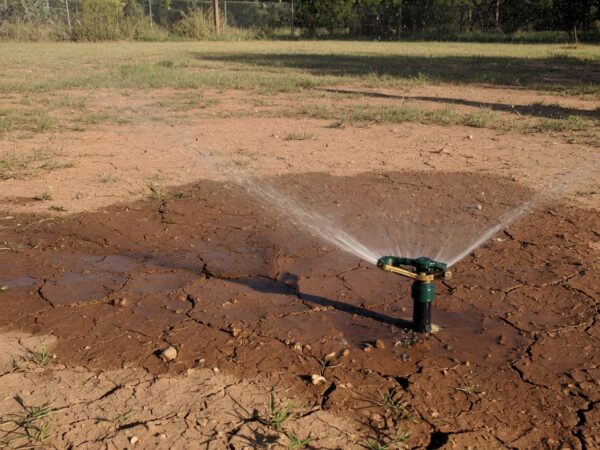
This city makes a rate mismatch obvious. The soil is clay. A spray head that puts down water faster than the soil takes it in builds a puddle in minutes, especially in a corner that already has the wrong nozzle. The puddle is not proof the lawn is watered. It is proof the surface filled before the root zone did. St. Augustine will root in that clay, but it will not send roots sideways to bail out a dry spot three feet away. Gulf humidity keeps blades wet longer once they are soaked, which is a fungal risk if the wet corner is also the corner that runs at dusk.
Wind along East Boulevard, Spencer Highway, and the open lots toward SH-225 changes where the water lands, which changes the area in the math. A misted spray that drifts into the street is no longer covering the square feet you used on paper. Occasional freezes add a cracked nozzle that throws a sheet while its neighbors still rotate. That one head unmatches the zone. Older yards often carry mixed nozzles on one valve. They will not balance until the zone is one family again.
Matched-rate checklist
- List every head on the zone: full, half, quarter, or strip, and the nozzle number actually installed.
- Confirm the flows scale with the arc. A quarter should not carry the same gallons as the full circle beside it.
- Reject any zone that mixes fixed sprays with rotors, or fixed sprays with low-rate rotary nozzles.
- Read the nozzle chart at the pressure you measured at a head, not at the hose bib.
- Reset arcs after mowing. An adjustable nozzle opened too far is an unmatched nozzle.
- Watch a ten-minute run. Puddles at corners and dry middles are the field version of the math.
- Separate turf, strips, and beds onto their own stations before you chase the perfect runtime.
- After any nozzle change, run the zone and look at the sidewalk. Water on concrete is failed match or failed arc.
Set the minutes only after the rates match
Once a zone is one family, runtime is simple. Decide the depth you want, divide by the zone’s inches per hour, and split that time into cycles if the clay starts to puddle. A common Gulf Coast guide for St. Augustine is on the order of an inch a week in ordinary weather, counting rain, with more during a hard dry spell. That is a turf guide, not a city ordinance. Follow the current City of Deer Park watering rules, and do not let a mismatched nozzle talk you into doubling the schedule.
If the zone map in your head does not match the nozzles in the ground, a sprinkler maintenance visit is the shorter path. Bring the controller’s zone list if you have one. Deer Park Sprinkler Repair can sort the rates and the hardware at (281) 764-7088. Matching precipitation will not fix a broken pipe. It will stop a healthy pipe from watering the corner four times as hard as the lawn.