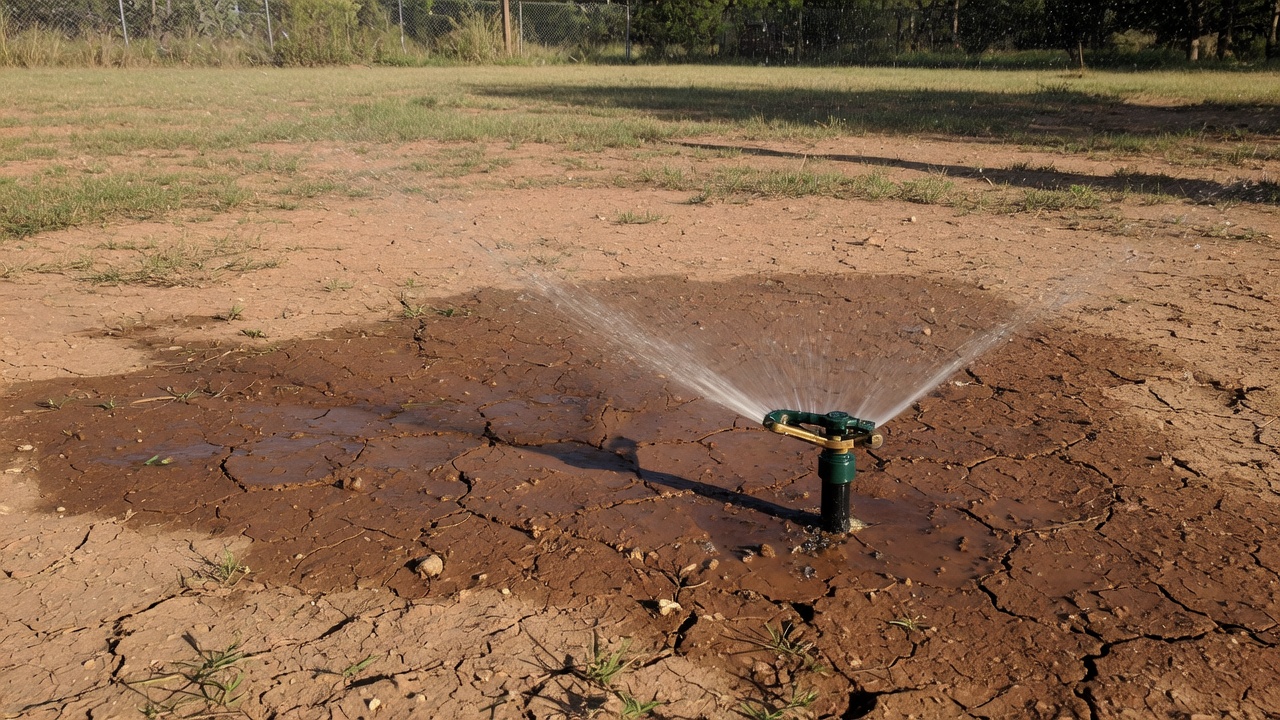
The sidewalk along a Spencer Highway lawn is already shining, the curb has a thin sheet of water, and the St. Augustine a few feet in is still dry at the soil line. That is not coverage. The nozzles are stacking water faster than Gulf Coast clay can take it in, so the extra leaves for the gutter before the roots ever see it.
An MP Rotator nozzle is a way to slow that rate without trenching a new zone. It is not a new brand of spray, and it will not rescue a zone that is short of pressure or a head that is cracked. The choice is a retrofit, a zone split, or a move to rotors. The clay decides which one is honest.
Runoff is a rate, not a vibe
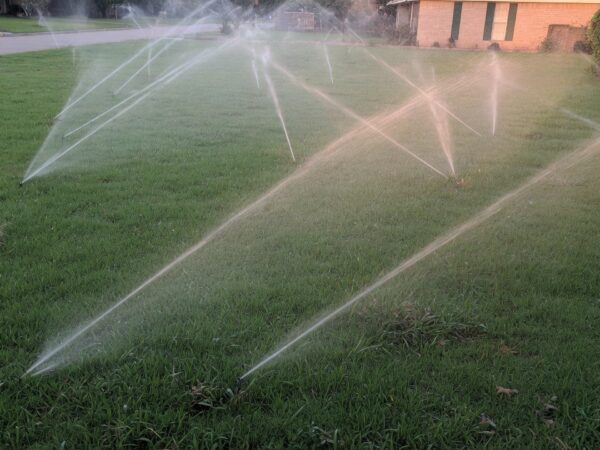
Every nozzle has a precipitation rate: the inches it would pile up in an hour if nothing ran off and nothing evaporated. Fixed sprays on a typical front yard land around 1.5 to 2 inches per hour when spacing and pressure match the catalog. Real yards run hotter than that. Heads sit a little close, pressure creeps up, and the mist rate climbs. Once the top of a compacted clay lawn seals, intake is often a fraction of an inch per hour. Everything above that rate becomes the river in the street.
Hunter’s standard MP1000, MP2000, and MP3000 nozzles apply on the order of 0.4 inches per hour at square spacing and about 40 psi. The short-radius MP800 is closer to 0.8, still far under a spray. Rotating streams also hold together in a breeze better than fog, which matters on open lots near SH-225. A lower rate only helps if the clock changes with the nozzle. A spray zone that ran twelve minutes may need the better part of an hour, broken into cycles. Leave the old runtime and the lawn dries.
Matched streams, or you recreated the problem
These nozzles are built around matched precipitation. A quarter-circle and a full-circle in the same family put down about the same inches per hour, because the full-circle uses more flow to cover more ground. That is the idea behind matched precipitation on a Deer Park lawn. Leave one old spray nozzle in the zone and that side floods while the rotators stay short. Match the family, and set the arc to the corner you actually have. An MP2000 fits most small front yards. An MP1000 is the short radius. An MP3000 is the wider side yard. If water from one head does not reach the next, you do not have head-to-head coverage, and cranking a short nozzle will not create it.
Pressure and the body you already own
Plan on about 30 to 55 psi at the head, with 40 psi as the middle. Below that, the streams stall. Above that, the droplets get fine and the rate climbs. Read pressure at the farthest head while the zone is running, not at a hose bib with everything off.
The nozzle carries a small screen. A main break, a fresh install, or grit pulled back through a low head will plug it. When one head stalls and the others spin, rinse the screen before you replace the gearbox. The nozzles thread onto the same male stem as a standard spray nozzle, so you do not need a new lateral to try this. That is why a nozzle retrofit often comes before a larger sprinkler installation change. Flush with the nozzles off until the water runs clear, then install them.
When this nozzle is the wrong fix
Do not thread them onto gear-driven rotors. The body, the thread, and the precipitation rate are a different job. If the yard is wide and open, the real comparison is rotor to rotor, which is the subject of Hunter versus Rain Bird rotors for Deer Park yards, not a spray-nozzle swap. Do not use them to prop up a zone that collapses as soon as the valve opens. Lower flow can help an overloaded zone, but only after you know the gallons. If the last heads barely rise today, split the valve or pull heads before you blame the nozzle.
A cracked pop-up, a tilted riser, or a leak at a fitting is not a nozzle problem. Rotating streams will not seal a split body, and a longer runtime will only feed the leak. That is sprinkler repair, and it belongs first. Skip the swap on a hedge that needs a shrub spray aimed into the leaves. Turf and shrubs rarely share a runtime.
Runtime, cycles, and St. Augustine
In a humid growing season, St. Augustine often wants about an inch of water a week, counting rain. Shade wants less. A storm week wants none. At roughly 0.4 inches per hour, that inch is on the order of two and a half hours per week, not per morning. Split it into early starts, then into cycles of about fifteen minutes with a half-hour soak between them. If water reaches the sidewalk early, shorten the cycle. Do not water at dusk. Warm humid nights and a wet leaf are how brown patch starts. A can in the overlap is the check. A wet gutter and a short can means the rate is still wrong.
Deer Park conditions: clay that seals, grades that drain to pavement
Soils from the older lots along East Boulevard out through Spencerview are Gulf Coast clay. Dry, it seals. Wet, it holds water. Humid summers mean evaporation is not the main loss. The limit is infiltration, so one long run still fails. Flat grades between Center Street and Spencer Highway give the surplus a paved exit. A puddle at the head is on its way to the storm drain.
They earn their place when the zone is still a spray zone, pressure is in range, and someone will lengthen the runtime and add soak time. They do nothing for a zone that is simply too large for the meter. If the city is on a watering schedule, a slower nozzle does not buy an extra day. The longer runtime still has to finish inside the window you are allowed.
Retrofit, split, or move to rotors
Retrofit the nozzles when the bodies are spray heads in sound shape, spacing is roughly head-to-head, and the complaint is water in the gutter or dry stripes beside wet ones. Buy one family, set the arcs, flush, and rewrite the program the same day. Split the zone when pressure falls as soon as the valve opens, when sun and shade share a clock, or when the head count is ahead of the gallons you measured. A slower nozzle cannot invent flow the service line will not pass. Move to rotors when the area is a wide open side yard and spray spacing would mean a forest of heads. Rotors also apply water slowly enough for clay, but they are a different layout, a different budget, and a different set of parts to keep.
Checklist: before you buy a bag of MP Rotators
- Confirm the zone uses spray bodies, not gear-driven rotors or drip.
- Read pressure at the farthest head while that zone runs. Stay near 30 to 55 psi.
- List each head’s real arc. Quarter, half, and full should be one nozzle family.
- Check head-to-head spacing. If the stream cannot reach the next head, fix that first.
- Flush with nozzles off until the water is clear, then install screens and nozzles.
- Rewrite the runtime the same day. Expect a longer weekly total, in shorter cycles.
- Put a can in the overlap and watch one full set of cycles from the sidewalk.
- If water leaves the lawn, shorten the cycle and add soak time. Do not add one long run.
- Repair cracked bodies and leaks before you retune the schedule.
- Recheck in August. Clay that took water in spring can seal hard by late summer.
If a matched, pressured, cycled set of MP Rotators still sends water to the curb, the limit is the layout or a leak, not the name on the nozzle. Call Deer Park Sprinkler Repair at (281) 764-7088 and say which zone reaches the pavement first. A pressure reading and a can test will show whether the next step is nozzles, another valve, or a redesign.