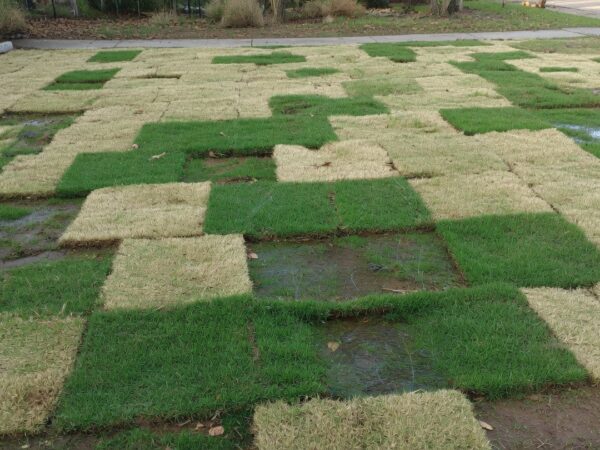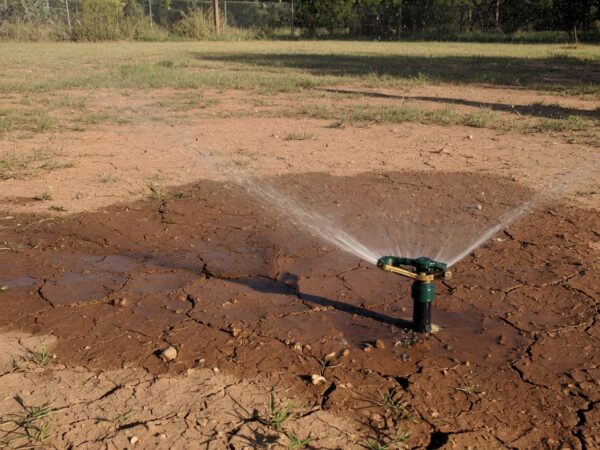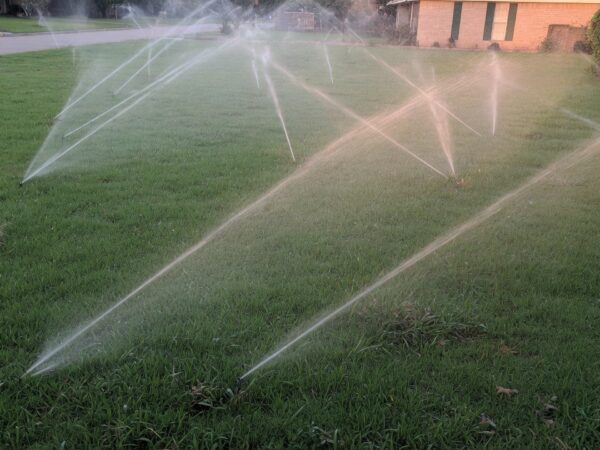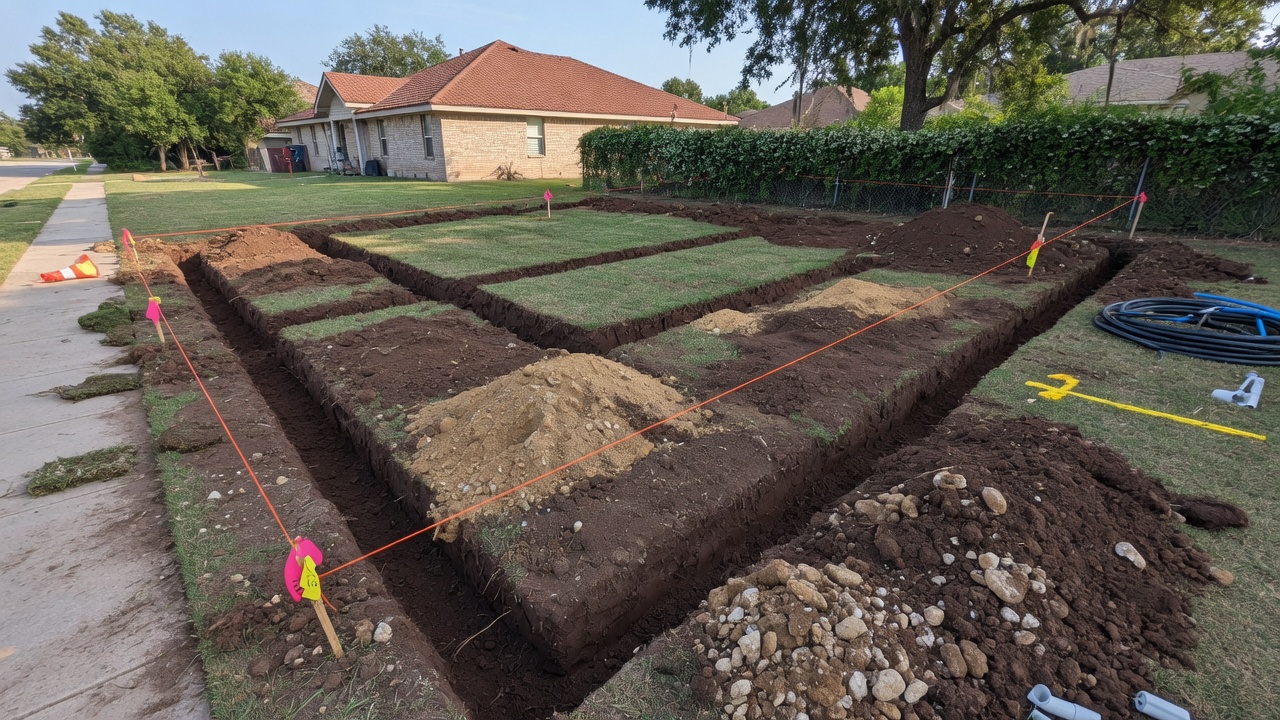
The sod is down, four rotors sit in the back yard at odd angles, and the beds along the foundation are already flagging while the turf nearest the heads is soggy. That is a rough-in, not a design. A new Deer Park lawn gets one chance to put pipe in before the grass knits and the beds are mulched. Spending that chance on “a head in each corner” is how the property ends up with dry diamonds, wet pavement, and a controller program nobody can explain.
Design is a sequence: measure the water you actually have, divide the yard by how thirsty each area is, space heads so they throw to each other, then size the zones so the gallons add up. Skip a step and the later sprinkler installation just locks the mistake underground.
Start with gallons and pressure, not with a head count
Static pressure at a hose bib, with nothing running, is a flattering number. The system lives on dynamic pressure: what is left while water is moving. Time how long a five-gallon bucket takes to fill from the irrigation supply with the hose bib open all the way. Gallons per minute is 300 divided by the number of seconds. Five gallons in 30 seconds is 10 gallons a minute. Five gallons in 20 seconds is 15. Do it when the house is also using water if that is how mornings work in that kitchen. A design that only functions when nobody is showering is not a design.
Write the number down and treat it as a budget. Every head you add spends part of it. Spray nozzles often spend around a gallon a minute for a half-circle and more for a full, but the chart for that exact nozzle at your pressure is the authority, not a rule of thumb from a different brand. If the budget is about 12 gallons a minute, a zone that adds up to 18 will not throw, no matter how nice the trench looks. That overload is the whole subject of too many heads on one zone. Design the split now, while the valve is still a mark on a sketch.
Hydrozones: sun, shade, turf, and beds are not one schedule
St. Augustine in full west sun on a Deer Park afternoon wants more water than the same grass under a live oak. Foundation shrubs want a slow drink at the root, not a spray that wets the leaves and the brick. A vegetable bed, if you are starting one, wants a third schedule. Put them on different valves. A single zone with one runtime will overwater the shade, underwater the sun, and keep the foundation beds too wet on clay that already holds water.
Clay shrinks when it dries and swells when it is soaked. A foundation does not enjoy either extreme right against the slab. Beds at the house belong on drip or a careful low-volume zone with a known volume, not on the turf rotors “because the spray sort of reaches.” Keep turf water on the turf. Texas standards that Deer Park points installers toward also expect you not to water sidewalks, driveways, and the street on purpose. Arc the heads to the lawn. Incidental mist on a breezy day is not the same thing as a nozzle aimed at the curb.
Head-to-head, on purpose
Space heads so the water from one reaches the next. That overlap is what prevents the dry diamond, and it is the idea behind head-to-head spacing. On a new lawn it is tempting to stretch rotors to save a head. Stretched spacing works on paper until the pressure is a little low or the wind off an open lot knocks the stream down. Then the middle dies and the program gets lengthened until the corners are mush. Buy the extra head. It is cheaper in the trench than as a cut-in next summer.
Match precipitation inside the zone. Do not mix a spray and a rotor, or a drip line and a spray, on one valve. Their rates are not in the same conversation. Corners get quarter-circle outlets, edges get halves, and the middle gets full circles from the same family. A zone that is “mostly rotors plus one spray by the porch” will always have a swamp by the porch.
Pipe, valves, wire, and the things builders skip
Size the pipe for the flow you calculated, not for whatever fitting was in the truck. A long run of undersized lateral will starve the last heads even when the zone total looks fine on a napkin. Keep the main a size the meter can actually feed. Upsizing pipe downstream of a small service does not create water. Put the valve manifold where you can open the box after the shrubs grow, not under a future patio and not in the driveway. Give every valve a name that matches the controller station.
Pull spare wires. A later zone is a short trench when a spare conductor is already in the pipe, and a cut across new sod when it is not. Put the controller on a real outlet, out of the weather, with a rain or moisture shutoff that sees the sky rather than a deep eave. Leave an as-built in the controller door: valve locations, pipe route, and which station feeds the west lawn.
Backflow and an isolation valve are part of the design, not accessories. The City of Deer Park requires backflow protection on irrigation tied to the potable system, a test when it is installed, and the paperwork that goes with a new device. Put the assembly where it can be tested and serviced, at the height the device requires, and where a cover can go on before a freeze. A backflow jammed against a fence, twelve inches too low because someone added a raised bed later, is a failed layout even if the grass looks fine.
Deer Park conditions: new sod, old clay, and a west sun
New sod on clay is a special kind of thirsty. The roots have not left the harvested mat, the soil under it may be compacted from construction traffic, and a long spray cycle runs off the seam between pieces and into the street. Design lower precipitation into turf zones, and plan cycle-and-soak from the first week rather than a single forty-minute start. West and south exposures, including open lots toward the Pasadena side and yards with no tree cover yet, will need more minutes than a shaded north side. Give them different zones now. You cannot split sun and shade in software if they share a valve.
Water in the early morning so the leaf dries. A builder default that runs at dusk will grow fungus before new sod roots down. Open ground near San Jacinto College and the commercial edges takes more wind and reflected heat than a sheltered backyard. If a fence is coming, move the blocked head on paper before the pipe is glued.
Checklist: design before the trencher shows up
- Bucket-test the irrigation supply. Write down gallons per minute, not just static psi.
- Sketch sun, shade, turf, foundation beds, and anything you will not want wet.
- Give turf, shade turf, and beds different valves. One runtime cannot serve all three.
- Space heads head-to-head. Do not stretch rotors to save a fitting.
- Keep sprays, rotors, and drip on separate zones. Match arcs within a family.
- Add up nozzle gallons and stay inside the bucket-test budget, with room to spare.
- Place valve boxes where shrubs and future patios will not bury them.
- Pull spare wire. Put a rain shutoff where rain can actually hit it.
- Set backflow and a reachable isolation valve where they can be tested and covered.
- File an as-built in the controller. Include the city backflow test for the new assembly.
If the sod is already down and the builder zones are the plan by default, there is still time to change it before the clay opens into a permanent trench scar. Call Deer Park Sprinkler Repair at (281) 764-7088 or use the contact page and say whether water and pressure have been measured. A design that starts from the bucket test is shorter than a summer of moving heads.