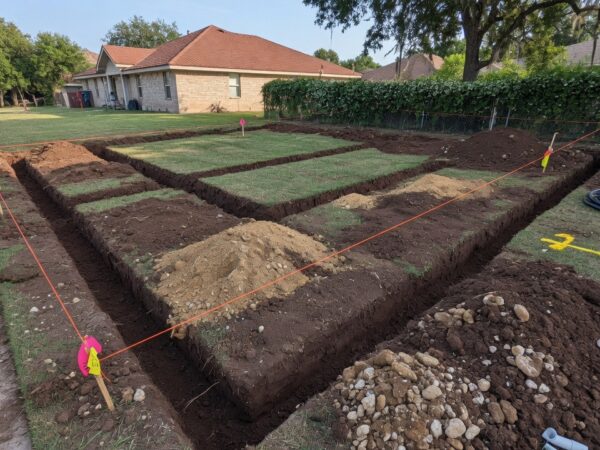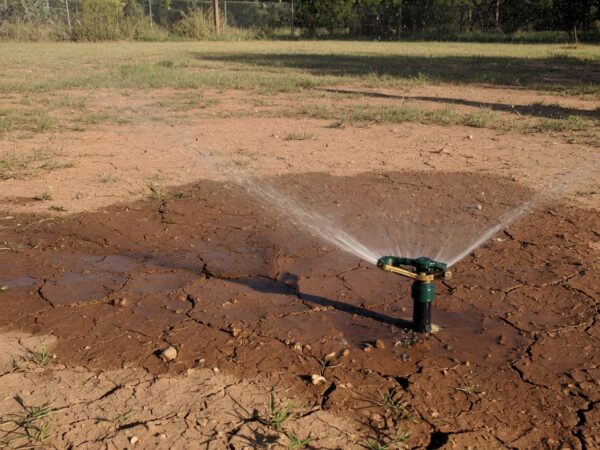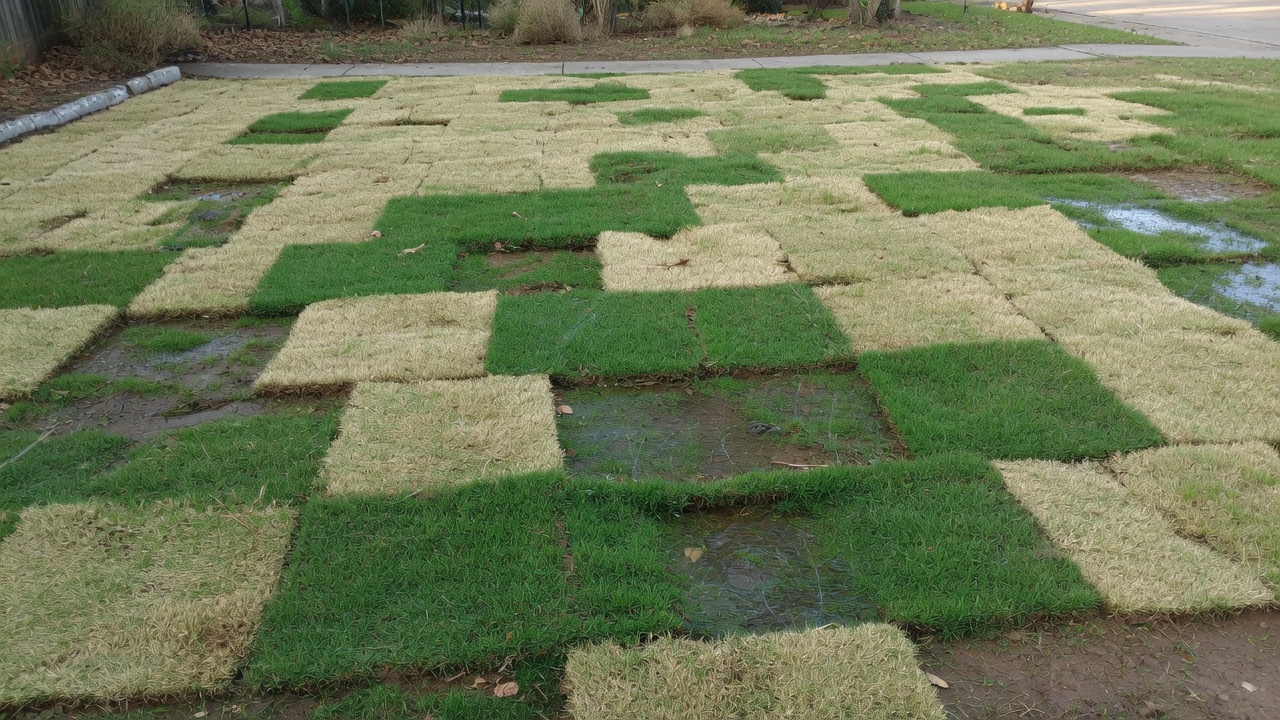
The pallets are down, the seams are tight, and three days later the yard is a map of the irrigation system. Dark green bands sit in front of each head. Tan seams show up exactly where two patterns were supposed to meet. The sod farm did not grow a striped product. New St. Augustine has no root system yet, and it will advertise every foot of bad spacing that the old turf had been hiding for years.
Established lawns in Deer Park can look acceptable on a mediocre zone because the stolons bridge a dry gap and the clay holds yesterday’s water. Fresh sod cannot bridge anything. The root is an inch long, the clay underneath may have been graded smooth and compacted by the crew, and the only water that counts is the water that hits that piece today. Uneven coverage after a sod job is usually an irrigation design that was always uneven, revealed on the week you can least afford the revelation.
Establishment water and design water are different
For the first ten to fourteen days, new sod wants the soil under the seam kept damp, which often means shorter cycles more than once a day, inside whatever Deer Park drought stage is currently allowed. That is a temporary program. It is not the summer schedule the lawn should keep in August. If you leave the “new sod” start times running for a month, you will have fungus, shallow roots, and a water bill that looks like a leak. If you never switch to more frequent, light cycles during establishment, the seams shrink and the dry gaps become dead gaps before the roots ever grab the clay.
Cycle and soak still matters during establishment. Clay will not absorb a long single run just because the sod is new. Water that sheets onto the sidewalk is not wetting the seam in the middle of the yard. Short cycles, a break, then short cycles again, aimed at damp rather than at a swamp. After the sod holds when you lift a corner, taper toward deeper, less frequent mornings. That transition is the week people either save the lawn or stripe it permanently.
Head-to-head is the coverage rule the sod is enforcing
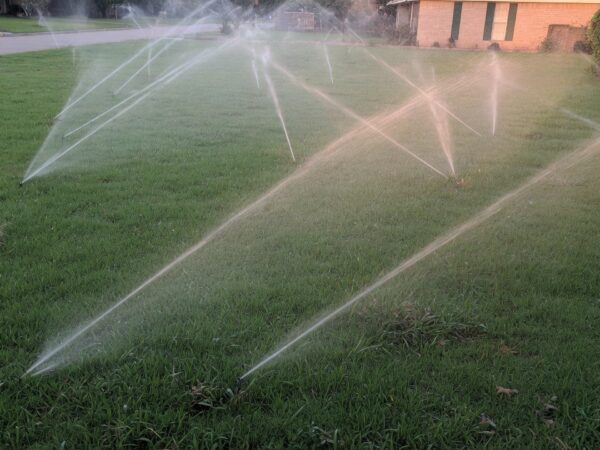
Spray heads are designed so the water from one head reaches the head next to it. That overlap is what makes the middle of the zone as wet as the area around the nozzle. When heads are stretched to save a fitting, the middle gets a fraction of the water and the new sod dies in a lane between them. Rotors have the same rule at a larger radius. A rotor that throws twenty-eight feet does not cover a forty-foot gap because the grass “usually does okay.” On old turf it almost did. On new sod it will not. The spacing article on head-to-head spacing is the layout version of what your seams are already showing you.
Nozzles have to match each other, not just the brand on the cap. A full-circle spray and a quarter-circle spray on the same zone should be matched-precipitation nozzles, so the quarter-circle puts down inches per hour in the same range as the full. Standard nozzles that are not matched dump far more water on the small arc. The corner floods, the middle of the full-circle head dries, and the sod makes the imbalance obvious in a weekend. Mixing sprays and rotors on one valve does the same thing at a larger scale, because their precipitation rates are not in the same family. Choosing heads is a design step, which is why choosing the right sprinkler heads belongs in the conversation before the next pallet, not after the brown lanes appear.
Grade changes bury the pattern you used to have
Sod crews grade. They have to. Low spots get fill, high spots get cut, and heads that were flush in May are either buried or standing an inch proud of the new surface. A buried head sprays into the soil and the new sod around it drowns while the radius never leaves the hole. A head that is suddenly too high mists, drifts in the wind, and leaves a dry ring at the distance where it used to water. Resetting height is part of the sod job. It is also ordinary sprinkler repair if the crew left and the pattern is already wrong.
Deer Park site conditions under a new lawn
The clay does not become potting soil because fresh sod is on top. It still takes water slowly, still seals at the surface, and still sends runoff to the curb if the cycles are too long. Yards near Center Street and along East Boulevard are small, and a sod job there often includes a new bed edge. Heads that used to throw to the old edge now throw into mulch or stop short of the new fence line. The dry triangle in the corner is a spacing problem created by the new boundary, not a bad piece of grass.
Larger lots in Parkwood and Spencerview show rotor gaps more than spray gaps. A side yard that was “close enough” with established turf becomes two green arcs and a tan center after the sod goes down. Wind across those open yards, and the breeze that comes off the SH-225 side of town, pushes a mist nozzle off the seam entirely. Fixed sprays with a coarser trajectory hold the pattern better than a fogging nozzle in that wind. Changing the nozzle is a smaller job than replacing the sod twice.
Shade still matters. Sod laid under oaks near the San Jacinto College area stays wetter and roots more slowly in the cool soil, while the parkway strip in full sun needs the overlap to be real or it toasts. One run time for both exposures was marginal before. It is unfair the week the roots are an inch long. If the zone cannot be split yet, aim the temporary program at the sun and watch the shade so it does not sit in a puddle.
Compaction from the delivery truck and the skid-steer is the condition people forget. Water hits the sod, fails to enter the clay, and runs to the low seam. Aeration is not the first-week task, but a screwdriver test is. If the probe will not enter beside a head that ran for twenty minutes, you are not under-watering. You are shedding. Shorten the cycle and add a soak, or core the worst panel once the sod can tolerate the traffic.
Checklist before you blame the sod
- Run each zone and watch where the water lands on the new surface, not where it used to land.
- Measure overlap. If a head’s spray does not reach the next head, the seam between them will show it.
- Check that nozzles on one zone are matched precipitation, and that sprays are not mixed with rotors.
- Lift every head that the grade buried and lower every head the grade left sticking up.
- Use short cycles with a soak while the clay is sealing, even during establishment.
- Keep the frequent new-sod program temporary, then step down once a corner of sod resists lifting.
- Separate sun and shade in your notes if they share a station, and do not drown the oak side to save the parkway.
- Look for runoff to the curb. Water in the gutter did not root the middle of the yard.
- Mark brown lanes on a sketch so the repair is a spacing fix, not a fertilizer guess.
- Confirm the current city drought stage so the extra establishment cycles are still legal.
Fix the pattern, then keep the grass
Replacing the brown sod without moving a head repeats the stripe. The lasting work is a head added where the gap is real, a nozzle changed where the arc was wrong, and a height set to the grade you have now.
If the new lawn is already telling you the truth about the zones, call Deer Park Sprinkler Repair at (281) 764-7088. We correct coverage and, when the layout needs it, fold the fix into a proper sprinkler installation change: another head, a split zone, or nozzles that match, from tight East Boulevard front yards to the longer rotor runs in Parkwood and Spencerview.