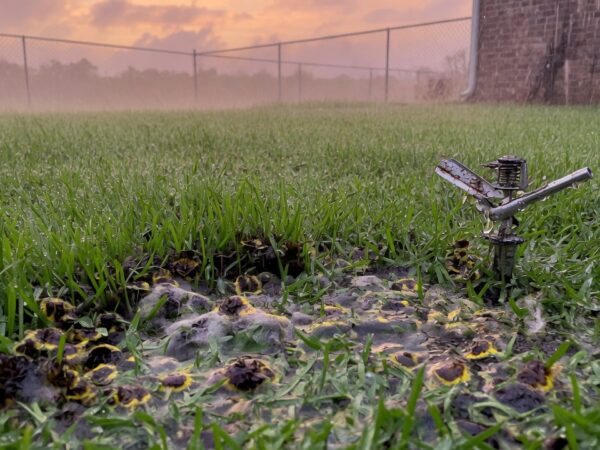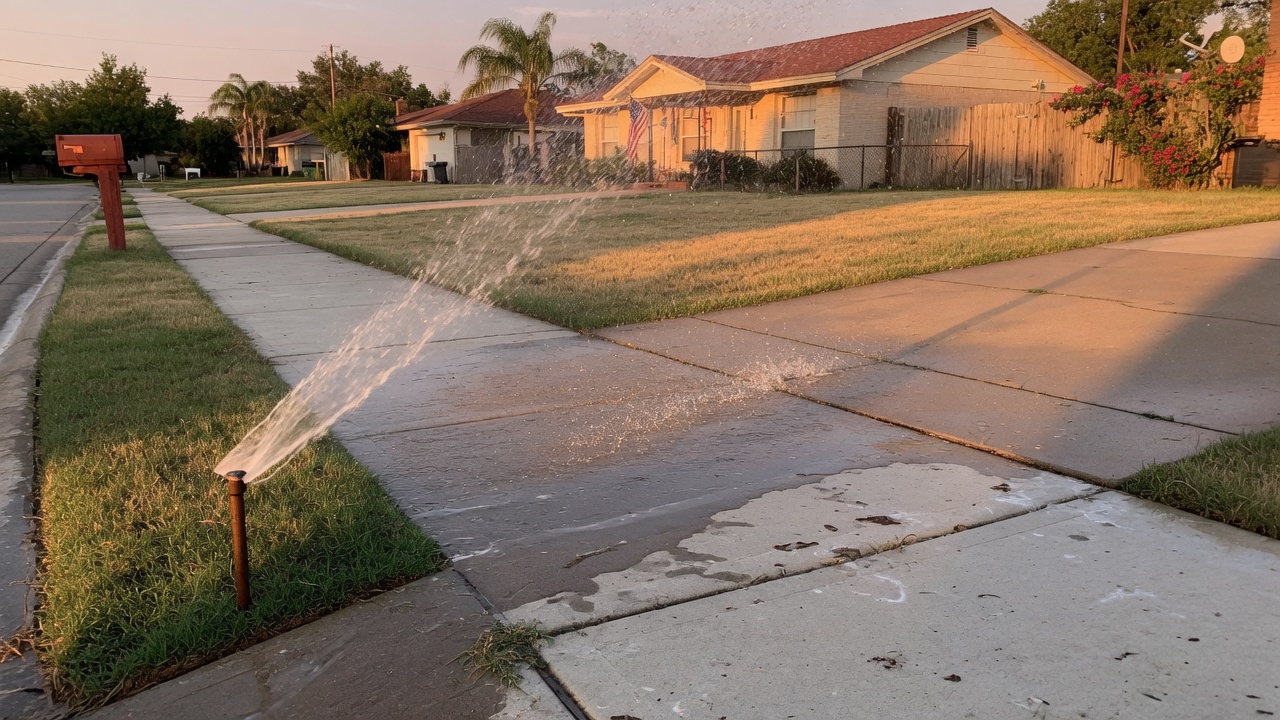
The lawn two feet back is dull and the sidewalk is dark. That combination is common on Deer Park parkways, and it is not “just how sprinklers are.” Water on concrete did not water St. Augustine. It cooled the curb, fed the algae film that makes a walk slick, and left the meter to count gallons the roots never saw. Overspray is a nozzle, tilt, or pressure problem. Adding minutes, which is the usual reply to the dull grass, only wets the concrete longer.
Some overshoot is obvious at noon: a stream that reaches the street on every pass. Some is a haze you only notice because the expansion joint stays black. Both count. The City of Deer Park is not irrigating your gutter, and a backflow device does not make wasted potable water harmless. It only keeps yard water from slipping back into the supply. The gallons are still yours to pay for.
Arc, tilt, and the head that sank
A quarter-circle nozzle that has been twisted toward a half-circle will throw across the walk even when the head is in the right spot. Adjustable nozzles drift. Mowers clip them. A kid’s bike does the rest. Fixed-arc nozzles hold their pattern better, which is why a recurring sidewalk spray often ends with a fixed nozzle set to the edge of the concrete and no farther. The radius still has to fit the yard. A nozzle that reaches the porch when you only needed the parkway is the wrong radius, not a badge of coverage.
Tilt does the same damage with a correct nozzle. Heads along a Deer Park sidewalk get nudged by edgers. A body leaning toward the street throws long over the concrete and short on the grass behind it. The fix is to straighten and re-level the head, not to turn the arc down until the pattern looks cowardly. A sunken head is the cousin of tilt. Soil and thatch build up, the pop-up no longer clears the grass, and the stream crashes into the turf lip and splatters sideways onto the walk. Raising the head to grade often stops the sidewalk film and improves the lawn in the same visit.
Strip nozzles exist for the narrow band between sidewalk and curb. A full-circle head in that strip cannot be “turned down” into a responsible pattern. It will wet concrete on the way to wetting grass. If the parkway is only a few feet wide, the hardware has to be a side strip or a short-radius spray, spaced so the streams meet along the grass and stop at the concrete. Spacing rules are in head-to-head spacing if the grass between those heads is the part going dry.
Pressure turns a stream into mist
Many spray nozzles are designed near 30 psi at the head. Push them well above that and the droplets shatter. Wind does not have to be a storm to carry mist across a walk. The lawn at the head gets a puddle. The far grass gets a rumor of water. The sidewalk gets the rest. Pressure-regulating heads and nozzles exist to hold spray bodies near their design pressure when street pressure is high. They are a better tool than partly closing a valve to “calm it down,” because a half-closed valve starves the last head and still may not stop the mist at the first one.
Rotors that pound the street are a different picture. The stream is a rod of water, not mist, and it is usually an arc set past the turf or a rotor installed where a spray belonged. Backing the arc off the concrete is the first move. If the rotor’s shortest radius is still longer than the yard, it is the wrong head for that edge. Do not solve it by aiming the stop at a parked car and hoping.
Cycle and soak does not excuse overshoot, but it limits the damage while you wait for parts. On clay, a head aimed correctly can still sheet onto the walk if the runtime is one long block. Water that cannot enter the soil runs downhill, and on a parkway downhill is the curb. Shorter cycles keep a corrected nozzle’s water on the grass. They will not redeem a nozzle pointed at the street. The habit side of that choice is in water-saving irrigation tips.
Deer Park conditions that push water onto concrete
Wind is the local amplifier. Afternoon breeze along Spencer Highway, East Boulevard, and the open run toward SH-225 takes mist that would have fallen on the lawn in a courtyard and puts it on the walk. The same pattern shows up in La Porte, which is why wind and sprinkler heads is the neighbor article. A still dawn test will lie to you. Set arcs when the breeze is up, or set them tighter than the dawn test suggests and confirm the grass still gets head-to-head coverage.
Clay and St. Augustine make the waste look like a coverage failure. The turf wilts, someone adds ten minutes, and the sidewalk stays wet into the school walk. Gulf humidity then keeps that film from drying, which is how a green slick builds on concrete that “always gets a little water.” It does not have to. Occasional freezes crack a nozzle into a fan that no longer respects the arc you set in October. After a cold night, watch the first run. A split nozzle throws a sheet, and the sheet’s favorite landing is the hardscape. Pasadena and Channelview parkways do the same thing for the same reasons. The concrete does not absorb your good intentions.
Overspray checklist
- Run the zone in the afternoon breeze. Mark every head that wets sidewalk, driveway, or street.
- Check arc against the concrete edge. Reset adjustable nozzles or replace them with fixed-arc nozzles that stop at the turf.
- Straighten heads leaning toward the walk. Raise heads that spray into the grass lip.
- On a narrow parkway, replace full-circle heads with strip or short-radius nozzles.
- If the pattern is mist instead of droplets, read pressure at the head. Regulate it instead of adding minutes.
- Watch for runoff even after the arc is right. Split the runtime so clay can take the water before it sheets to the curb.
- Look again after the next mowing. A nozzle bumped by a mower will be back on the concrete the next morning.
- Note any head that fans after a freeze. That is a cracked nozzle, not a programming quirk.
Stop paying for the gutter
Overspray is maintenance when the head, nozzle, and pressure can be put right without new pipe. It becomes a repair when the body is broken, the swing joint is split, or the zone was built with the wrong head an arm’s length from the curb. Either way the sidewalk is a symptom, not a place you are required to water. Schedule sprinkler maintenance when several heads drifted and the system otherwise runs. Schedule sprinkler repair when a head is broken, geysers, or will not hold an arc.
Deer Park Sprinkler Repair will set the edges back on the grass at (281) 764-7088. Tell us which side of the house wets the walk and whether the spray looks like mist or like a solid stream. Those two details decide whether the visit starts with a nozzle or with a pressure reading.