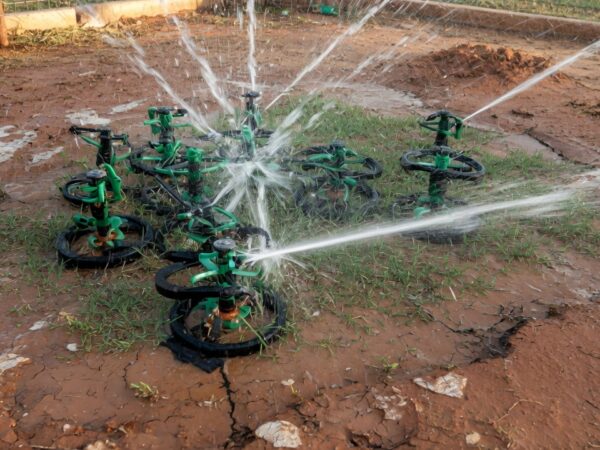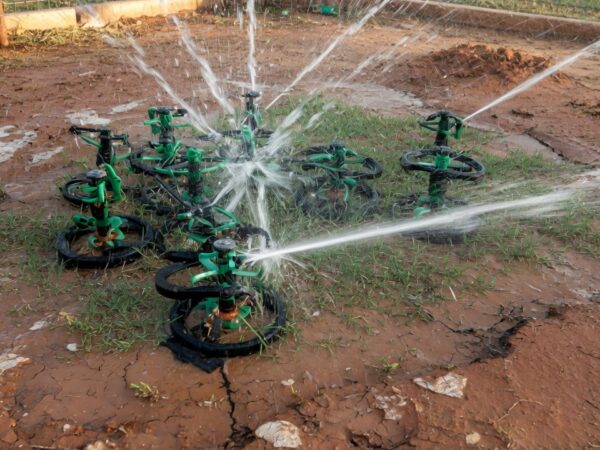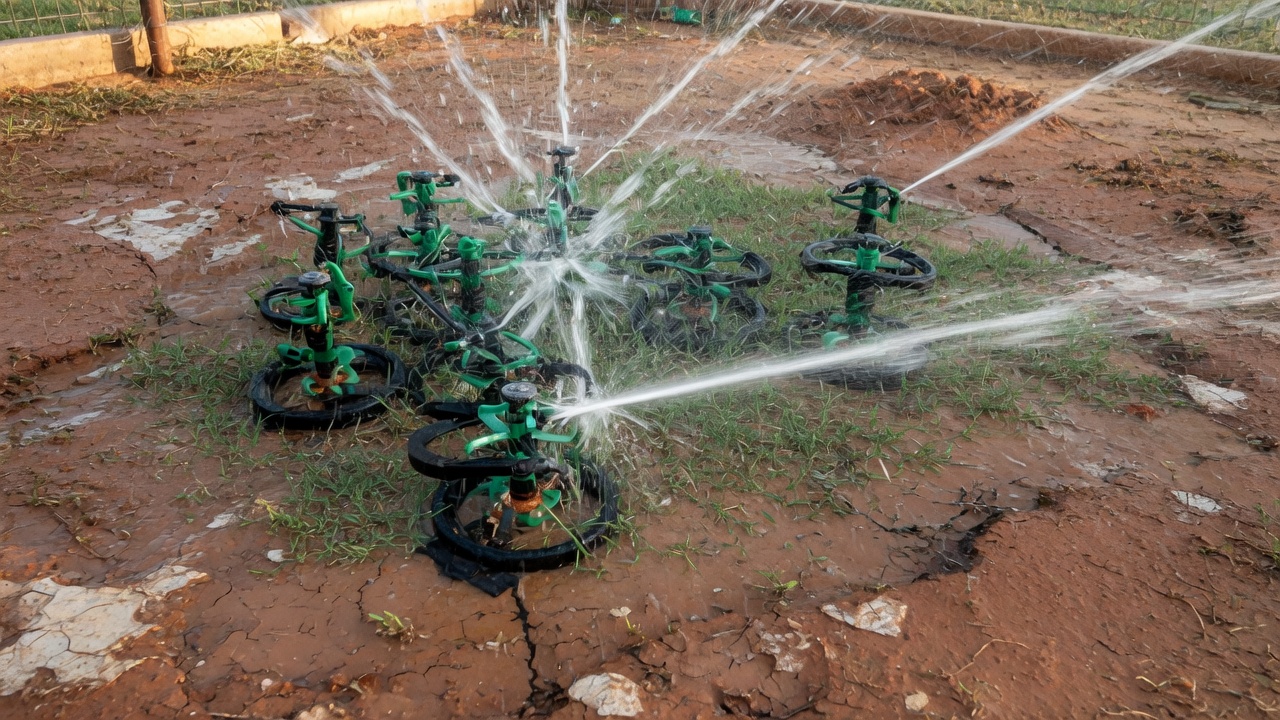
Zone three sounds fine at the valve and dies at the last head. The first two heads mist, the middle ones look acceptable, and the far corner never quite stands up. Adding minutes does not fix it. The zone is asking for more gallons than the pipe and the meter will pass, so pressure collapses before the end of the line.
Too many heads is a budget problem. You can spend the gallons on fewer outlets that throw correctly, or you can keep every head and give them a second valve. You cannot spend the same gallon twice. Guessing “just one more head” on an existing lateral is how a zone that used to work becomes the weak one.
Count gallons before you count heads
Time a five-gallon bucket from the irrigation supply, opened fully, while the house is using water the way it does on a normal morning. Gallons per minute is 300 divided by the seconds it takes. Twenty seconds is 15 gallons a minute. Thirty seconds is 10. That number is the budget for everything running at once on that station. It is not a promise that the city will hold the same number at 7 p.m. in July, when half the street is watering. Test again at the hour you actually intend to run. A zone designed on a quiet weekday morning can fail every evening without a single broken part.
Then add up the nozzles. Read the chart for that model at the pressure you really have, not a remembered number from a different brand. A half-circle spray is often near a gallon a minute and a full-circle often near two, but the stamp on the nozzle wins any argument with a rule of thumb. Ten heads that average 1.5 gallons a minute want 15 gallons a minute. If the bucket said 9, the last heads were never going to make it. Friction makes it worse. A long run of undersized pipe spends pressure on the way, so the first head sees too much and the last head sees almost none. That pattern, fog at the start of the zone and a dribble at the end, is overload. Fog at every head is the opposite problem: pressure too high, and a regulator or a smaller nozzle, not fewer heads, is the conversation.
Lookalikes that are not an overloaded zone
A partly closed flow control on the valve, a solenoid that is not opening fully, a crushed lateral, or a leak that dumps water before the last head will starve the end of the zone too. Close the diagnosis before you redesign. Run the zone and watch whether a wet spot appears upstream of the weak heads. Turn the flow control fully open and try again. Run the same zone at dawn and at peak evening. If it only fails at peak, you are watching city demand sag, and the fix is a smaller flow total so the zone still works on a bad evening, not a speech about the utility.
A single clogged nozzle looks local: one head weak, the others strong. Overload looks progressive: better near the valve, worse as you walk away, and the whole zone improves if you temporarily cap two heads and run it again. That cap test is the cleanest proof you can do with a screwdriver. If capping two heads makes the rest stand up and throw to each other, you have your answer. The longer version of low-pressure causes sits in low water pressure on Deer Park zones. Use it if the cap test changes nothing.
Fixes, in the order that wastes the least money
Remove heads that water pavement, a fence, or a bed that should not be on this zone, and cap the riser properly so it is not a mud hole. Swap to lower-flow nozzles if the spacing still works. Multi-stream nozzles use fewer gallons than sprays at a similar radius, which is why an overloaded spray zone sometimes comes back to life without a new valve. Match the family across the zone or you will trade low pressure for a precipitation mismatch. If the area is simply too large, split it. A new valve, a new station, and a pipe that does not have to carry the old total is the straight repair. It is also the right moment to separate sun from shade if they were sharing this zone.
Upsizing the lateral helps only when the meter and the service can supply the flow and the current pipe is the bottleneck. A fatter pipe downstream of a small meter does not create water. A booster pump on a city supply is the wrong hobby. It can disturb the backflow arrangement, it may not be allowed, and it hides a design error behind a motor. Do not add one so a crowded zone can keep its bad head count. If this zone was born that way on a new lawn, the layout conversation belongs with designing irrigation for a new Deer Park lawn, not with a pump catalog.
What a split actually changes
Two zones of six heads, run one after the other, use the same gallons per minute as one zone of six. The yard gets the water. It just takes more minutes on the clock, which clay prefers anyway because you can soak between cycles. One zone of twelve uses twice the flow and gives you dry ends plus runoff at the heads that still have pressure. The clock has room. The meter often does not. Program the new stations in the early morning, with cycle-and-soak, and do not stack them on top of each other by setting two programs that overlap. Overlap is how you quietly rebuild the overload you just paid to remove.
Deer Park conditions: evening demand and clay that punishes long runtimes
Residential services in this part of Harris County are often comfortable in the early morning and tighter in the evening, when irrigation across the neighborhood and ordinary household use overlap. Designing a zone to the best minute of the day is how Spencerview side yards and older, longer laterals near Center Street look fine on a test and fail every July at dusk. Run the bucket test at the miserable hour, not the flattering one.
Clay changes the temptation. Weak heads make people lengthen the runtime. The heads near the valve, which already had pressure, then dump extra water onto soil that cannot take it, and the sidewalk gets wet while the far corner stays dry. Fix the flow, then set the minutes. St. Augustine still wants roughly an inch a week in the growing season, counting rain, delivered in the morning. Humidity makes an evening makeup cycle a bad trade: fungus on the wet half, dust on the dry half.
Checklist: prove the zone is overloaded before you buy parts
- Bucket-test gallons per minute at the hour the zone will really run.
- Add up nozzle flow from the manufacturer chart at your pressure.
- If the nozzle total is over the bucket number, the zone is over budget.
- Fog near the valve and a dribble at the end points to friction and overload.
- Fog at every head points to high pressure, not too many heads.
- Cap two heads and run the zone again. If the rest recover, the count was the problem.
- Rule out a stuck flow control, a leak, and a crushed pipe before you redesign.
- Prefer fewer gallons: remove wasted heads, use lower-flow nozzles, or split the valve.
- Do not upsize pipe the meter cannot feed, and do not add a booster to hide the math.
- After the split, keep station times from overlapping, and water in the morning.
If the cap test helped and you want the zone split without turning the lawn into a guess, call Deer Park Sprinkler Repair at (281) 764-7088. A redo that starts from the bucket number is a smaller project than replacing heads that were never the failure. When the pipe itself is the limit, sprinkler repair and a new valve beat another season of the far corner going brown. New work that needs a clean layout belongs under sprinkler installation.