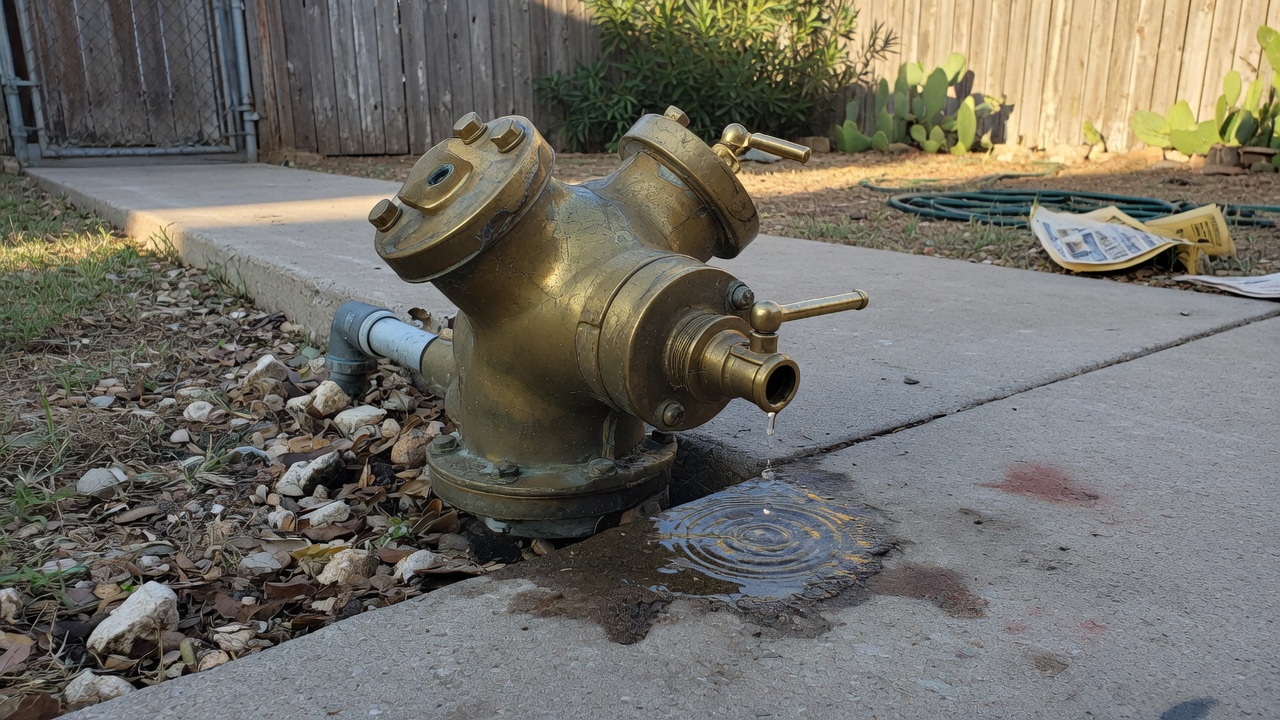
A pencil-stream leaves a small brass port on the backflow and darkens the concrete under it. It is easy to call that “just a test cock” and tie a bag over it. The port is how a tester checks whether the assembly still protects the drinking water. If it is open, it is a valve that needs a turn. If it is closed and still dripping, the seal is finished. Either way the City of Deer Park still expects the device to work and to be tested, and a bag is not a repair.
The first job is to name the port. Backflow bodies have more than one place water can leave, and plugging the wrong one can hide a failure that is supposed to be obvious.
Which port is actually leaking
A pressure vacuum breaker, the assembly often sitting a foot or more above the highest head, typically has two test cocks plus a shutoff on each side. A double check and a reduced-pressure assembly typically have four test cocks. On a reduced-pressure device there is also a relief valve vent, usually centered and aimed to dump water downward if the checks fail. That vent is not a test cock. Water from the relief vent means the assembly may no longer be protecting the potable supply. Do not cap it, do not pipe it into a drain in a way the manufacturer forbids, and do not keep irrigating as if it were a nuisance drip. Close the irrigation shutoff and have the assembly tested.
Test cocks themselves are small valves. Many are a quarter turn. Turn gently the short way until the flow stops, and do not crank past the stop or you will twist the stem off. If you reach a firm stop and the drip continues, position is not the problem. The cock’s seal, or the cock body, is. Manufacturers do not all agree on whether the screwdriver slot looks parallel or crosswise when closed, so use the water as the indicator, not a rule remembered from a different brand. A stream that starts and stops cleanly as you turn is an open cock. A seep that never stops is a bad seal.
The fixes that are allowed, and the ones that are not
An open cock gets closed, then watched with the system running and with it idle. If it stays dry, you are done except for asking why it was open. The usual reason in Deer Park is winterizing. Someone drained the assembly and never closed the ports, which is the mistake paired with how to winterize a sprinkler system in Deer Park. Close them before you open the isolation valve next time, or the first start of spring is a fountain.
A cock that drips when closed gets repaired or replaced, not capped with a hose cap. Testers need those ports, and a cap hides a failed seal until test day. Below-grade double checks are the exception: state standards require threaded, watertight, non-ferrous plugs on the test cocks except during the test. A missing plug is both a leak and a compliance problem. A random hose-reel cap is not that plug.
Anything beyond closing a cock or replacing the cock itself, including a leaking relief vent, a check that will not hold, or a cracked body, is an assembly repair. The City of Deer Park requires that work to be done by a licensed backflow tester and permitted. The owner is responsible for the annual test and for keeping the device in working order. Tests are filed through the city’s program, which uses Backflow Solutions Inc. for the electronic records, and a new device carries a one-time city fee on top of whatever the tester charges. None of that is accomplished by tightening a port until the brass strips. When the leak is more than a cock, schedule backflow testing and the repair together so the passing report is the end of the visit, not a second appointment you forget.
How to watch it without making it worse
Dry the area. Close the suspect cock with a short turn. Open the irrigation shutoff slowly if you had closed it. Run one short manual cycle and then shut the system off. Look at each cock, not only the one that started the puddle, and look under the relief vent if the device has one. A drip only while a zone runs can be pressure flexing a weak seal. A drip at rest can be the same seal, or a cock left cracked. If you see water at the relief and also at a cock, believe the relief first. That is the device telling you a check is not holding, and closing a test cock will not restore protection.
Do not cycle the cocks as an experiment. Repeated cracking under pressure sprays water and can drag grit into the test passages. One careful look is enough. If the body is dumping steadily from the relief, leave the isolation valve closed until it is tested. A wet pad is the small loss. A cross connection into the house supply is the reason the device exists.
Deer Park conditions: humidity, freezes, and a city that keeps the record
Humid air and sun beat on above-grade vacuum breakers and reduced-pressure assemblies all summer, then an occasional freeze empties the conversation into the bonnet and the cocks. Ports left open after a cold snap, or seals nicked by ice and debris, show up as the pencil-stream in March. Clay does not hide the evidence. The water sits on the pad, stains the concrete, and grows a green film, so a “small” leak is visible if anyone walks the side yard. Lower lots stay damp enough that people confuse condensate and splash with a failed cock. Dry it and watch, as above, before you buy parts.
The city’s backflow program is not optional color. Assemblies are tested at installation and at least annually, the owner pays for the test, and repairs and replacements are permitted and performed by a recognized tester. A leaking cock on a device that is already due, or overdue, should trigger the test rather than a hardware-store cap. Records live with the city through its testing program, so “it was fine when we moved in” is not a file they can see. If you are comparing notes with a house in Pasadena or La Porte, use Deer Park’s rules for a Deer Park meter. The assembly on your service is the one this water department tracks. More of the test itself is laid out in what a Deer Park backflow test covers.
Checklist: a test cock that will not stay dry
- Identify the port. A relief vent on a reduced-pressure device is not a test cock.
- If the relief vent is dumping, shut the isolation valve and schedule a test. Do not cap the vent.
- Turn a test cock only the short way, to a stop. If the drip ends, it was open.
- If it still drips at a firm stop, the seal or the cock has failed. Do not force it.
- Do not leave a hose cap as a permanent repair on an above-grade assembly.
- On a below-grade double check, use proper threaded watertight plugs, off only for the test.
- After any winter drain, close the cocks before you restore pressure.
- Dry the pad and watch one cycle plus a rest period so you know which port is active.
- Send assembly repairs through a licensed tester, with the city permit and the report.
- If the device was opened, repaired, or replaced, do not put the system back in service on an old test.
A test cock you are babysitting with a bucket is either open or failed, and the annual test is still due. Call Deer Park Sprinkler Repair at (281) 764-7088 and say which port is wet and whether the relief vent is dumping too. Pair the visit with sprinkler repair only after the assembly is actually protecting the supply. A green lawn is not proof that the backflow is doing its job.