The letter does not look like a sprinkler bill. It mentions a test due date, a customer confirmation number, and a company you may never have hired. A lot of Deer Park homeowners set it on the counter and assume it is an advertisement, right up until a follow-up warns that water service can be turned off. It is not an advertisement. The City of Deer Park tracks irrigation backflow assemblies through Backflow Solutions Inc., and the date on that notice is the city’s date, not a suggestion from a contractor who wants a spring route. The assembly on the side of the house is the only thing standing between the irrigation piping and the potable line that feeds the kitchen. Testing it is how anyone knows it is still standing there in more than name.
Federal and state drinking-water rules require every public supplier to run a cross-connection program. Deer Park’s program, which the city ties to Texas Commission on Environmental Quality requirements, says backflow assemblies are tested when they are installed and at least once a year, with extra tests if the hazard calls for them. The property owner is responsible for the test and pays for it. A new device also carries a one-time city fee, published as thirty-five dollars per new assembly. None of that is a maintenance upsell. It is the condition attached to keeping City of Deer Park water in the house.
What the assembly is preventing
Backflow is water moving the wrong direction. Back-siphonage happens when pressure in the city line drops, a main break, a hydrant opening hard, a heavy demand on a summer evening, and water from your irrigation is sucked backward toward the meter. Backpressure happens when something on your side of the meter pushes harder than the city, which is less common on a simple lawn system and very real if a pump or an injector is involved. Either way, the water in the laterals is not drinking water anymore. It has been sitting in pipes under the yard, mixed with soil, fertilizer, and whatever leaked into a valve box. The assembly exists so that water cannot make the return trip.
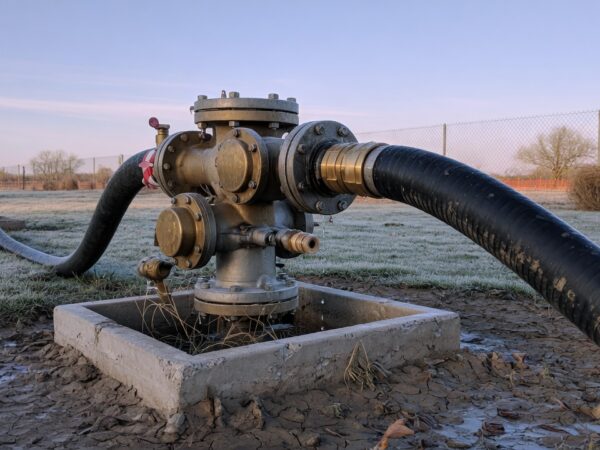
The common types are a reduced-pressure principle assembly, often called an RPZ, a pressure vacuum breaker, and a double check. An RPZ stands above ground and will dump water from a relief port if the checks fail. Texas standards expect it at least twelve inches above grade, where it will not be submerged, with room for gauges. A double check, where the city allows one and there is no health hazard, keeps its test cocks plugged except during the test. A pressure vacuum breaker has to stay above the highest head it protects. Use the device the hazard required, not the one easiest to hide.
What an annual test actually does
A licensed tester does not glance at the assembly and call it good. Gauges get attached to the test cocks, the shutoff valves are worked in a set order, and the numbers have to fall inside the limits for that type of device. On an RPZ the test is checking that the check valves hold a required difference and that the relief valve opens when it should, instead of staying shut and letting a failure go silent. On a double check the test is whether each check holds. Springs fatigue, rubber discs pit, and grit from a meter change or a main repair keeps a check from seating. A device can look square and painted and still fail the gauge.
Deer Park uses BSI to store the reports. The tester enters the result online, and that database is what the city reads. The due date repeats on the same calendar mark each year, not twelve months from the last convenient visit. Testing early does not move the anniversary. Keep the customer confirmation number on the reminder. The tester needs it to pull the right record.
Failing to report is treated like not testing. Overdue assemblies can escalate to termination of water service. Owners can delegate the appointment. They cannot delegate the consequence. Repairs have to be done by a licensed tester, permitted with the city, and tested again. The one-time fee on a new assembly is separate from the tester’s fee.
Why Deer Park assemblies fail in ordinary years
You do not need a dramatic freeze to fail a test. RPZs sit outdoors along Spencer Highway driveways, beside Parkwood garages, and on slabs toward the San Jacinto College area. Warm, wet air, mineral scale, and grit keep the discs from sitting flat. Fertilizer the assembly was installed to isolate is also hard on the rubber. The test exists because those parts are designed to wear.
A test cock is a small valve for gauges. It is not a hose bib, and it is not a bleeder you leave cracked “so it will not freeze.” An open or weeping test cock can move the meter all night. On a below-grade double check those ports are supposed to stay plugged except during the test. A drip from that brass petcock is not a sprinkler head. What to do before it becomes a stream is in backflow assemblies with leaking test cocks.
An RPZ is full of water and fully above grade. A hard night can split a bonnet or crack a check cover. You may see the relief pouring the next morning, or you may not see it until March, when a gauge cannot build a reading. Preparing that device is part of winterizing the sprinkler system. Draining or insulating it before a forecast freeze is cheaper than a cracked body and a new-device fee.
Get the site ready for the tester
- Find the assembly before the appointment. Clear shrubs, stored bins, and mulch so both shutoff valves and all test cocks can be reached without digging.
- Confirm it is not sitting in a hole. An RPZ that has settled below grade, or that floods when the relief opens, needs the grade fixed. A tester cannot honestly pass a device that will be submerged the next time it discharges.
- Do not paint over the test cocks, the relief port, or the nameplate. The model and serial number have to be read into the report.
- Have the BSI customer confirmation number ready so the result lands on your assembly and not in a pile of unmatched tests.
- Keep the irrigation controller available. The tester may need the water on and the zones quiet. Do not start a zone into the gauges.
- If the relief valve is already discharging continuously, close the inlet shutoff to stop the waste and say so when you book. That is a repair, not a routine pass.
- After a pass, put the report date on a reminder that matches the city’s due date, not a guess of “about a year.”
Leave the shutoff handles for the person with the gauge if you are not sure which is the inlet. Do not pull the assembly to clean it and pipe it back backward. The direction of flow is marked on the body, and a reversed RPZ is not protection.
A failed test is a repair, not a negotiation
If the numbers miss, the assembly is not protecting the city main or your own household piping. The usual repair is a rubber kit, new checks, or a relief-valve service, followed by a retest the same visit when the parts are on the truck. A cracked body, a frozen bonnet, or a device that is the wrong type for the hazard means replacement, a permit, the city’s new-device fee, and a test on the new serial number. Skipping the retest because “the parts are new” leaves you non-compliant in the BSI record, which is the record the city actually reads.
The annual test costs less than a month of watering a leak. When you schedule backflow testing, say whether the relief port is already leaking and whether you have the confirmation number. If the assembly is buried or below grade, say that too. Questions about a notice can start at (281) 764-7088 or through contact. Have the due date ready. A device that has never been tested will not become safer because the letter was easy to misfile.