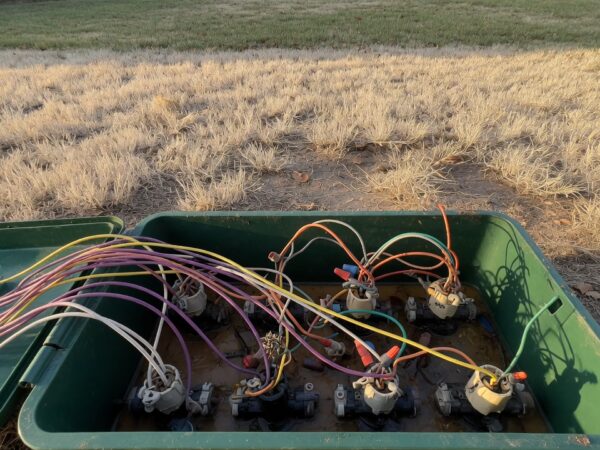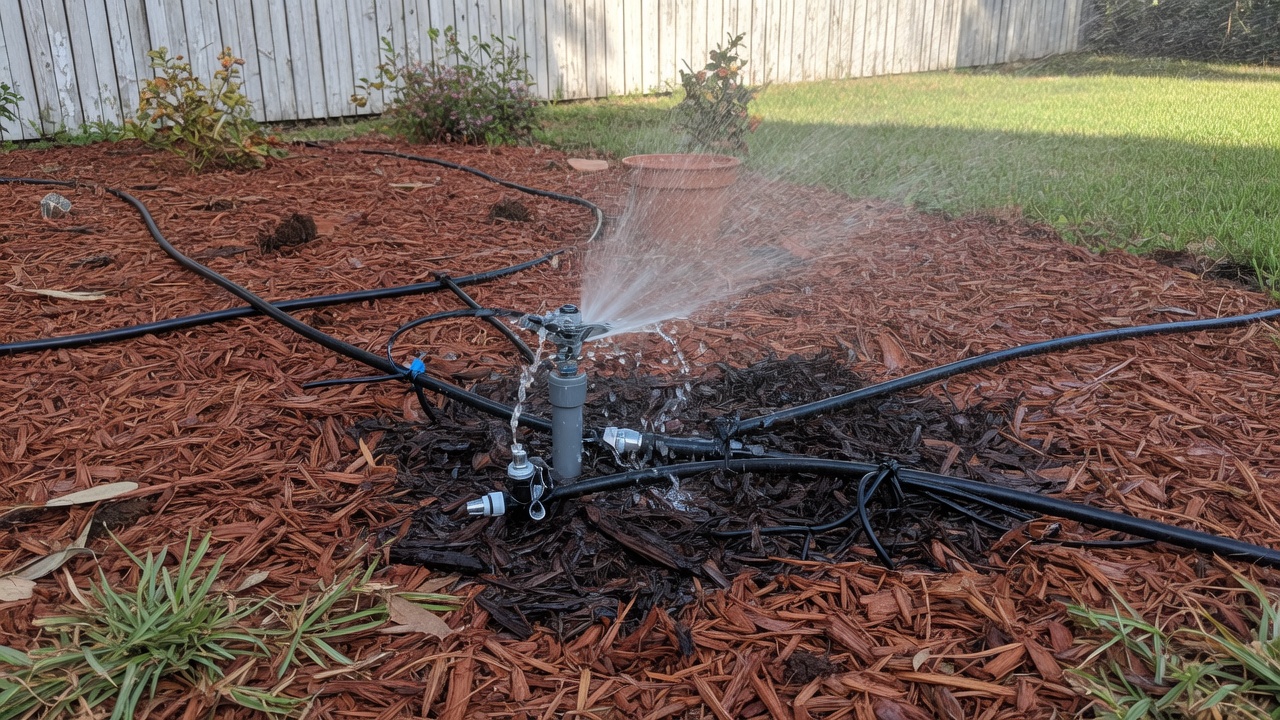
Someone teed a quarter-inch line off the last spray head so the roses would get a little water. The lawn at that head is brown, the mulch is a swamp, and one emitter has blown off and is drilling a hole in the bed. Both halves of that invention are doing the wrong job, on a timer that can only be right for one of them.
Spray and drip can live on the same property. They should not live on the same valve. The mistakes below are the ones that show up on Deer Park foundation beds and along turf edges, and each one has a specific reason it fails rather than a vague plea to “do it right.”
The runtime cannot satisfy both rates
A spray zone finishes its work in minutes. A drip zone finishes in a long, slow run, often an hour or more, because each emitter is supposed to wet a small volume of soil, not throw water across a lawn. One start time is one number. Set it long enough for the emitters and the spray side floods, runs to the sidewalk, and rots the crown of the St. Augustine. Set it short enough for the turf and the shrubs get a sip that never reaches the root depth clay requires. There is no clever middle. This is the same mismatch described for nozzles in matched precipitation, except the two rates are not even close.
People try to cheat with a ball valve cracked halfway on the drip leg. That does not create a second runtime. It creates an unpredictable dribble that changes every time someone bumps the handle, and it often means the spray heads lose pressure too. A zone is one hydraulic event. If two plantings need two durations, they need two valves.
Pressure that is right for one is wrong for the other
Spray heads want something like 30 to 45 psi to throw. Drip emitters are built for much lower pressure, commonly regulated around 20 to 30 psi, and many cheap emitters split or pop off when they see full spray pressure. Put a drip regulator on the whole zone and the sprays will not reach. Leave it off and the drip side mists, wets the leaves, and blows fittings apart. Either way you have chosen which half of the zone to ruin.
Filtration sits in the same gap. Emitters have tiny passages. A spray zone sends grit, algae, and pipe scale straight at them. Without a filter on a drip-only valve, usually a fine screen in the 150-mesh range ahead of the regulator, the emitters clog from the far end back and you “fix” it by raising the runtime, which floods the two emitters that are still open. Sprays do not want that filter restriction, and you should not hide a filter inside a nozzle cross you cannot find later. The hardware stack for a real drip zone is valve, then filter, then pressure regulator, then tubing, with a flush end you can open. That stack is the point of a dedicated drip irrigation zone, not an accessory on a rotor.
Elevation, drainage, and the lowest plant
After a spray zone shuts off, the lateral drains to the lowest head unless the heads have check valves. Tee a drip line at that low point and the whole zone’s leftover water dumps through one emitter or one open barb. One plant drowns. The high emitters suck mud back as the line drains, and they clog. The lawn heads at the high end spit air and soil the next morning. None of that is a plant problem. It is low-head drainage wearing a drip disguise.
Fix it by not sharing the lateral. If a drip zone itself changes elevation, use pressure-compensating emitters with built-in checks, and do not put the flush cap at the bottom of a slope where it becomes the drain for the bed. On flat Deer Park lots the slope may only be a few inches toward the street, and that is still enough to pick a victim plant every night.
The layout that actually works
Give the beds their own valve. Keep turf sprays or rotors on theirs. Tubing stays on the soil, under mulch, not stapled up into a shrub where it mists the leaves and sunburns them. Emitters go at the root zone, counted so you know the gallons per hour, and the runtime comes from that volume rather than from whatever the lawn was using. A flush end gets opened a few times a season until the water runs clear. The filter gets cleaned when flow falls off, not when the plants are already crisp.
Micro-sprays are not a loophole. A zone of only micro-sprays, with a filter and a regulator, can water groundcover. A micro-spray poked into a turf zone is the same mistake as an emitter, just louder. If the foundation planting needs a different rate from the lawn, it needs its own station. That separation is also how you keep constant moisture off the slab, which is the practical side of drip on foundation beds. New work should make the split before the trench is closed, which is a layout choice during sprinkler installation, not a patch with a barb fitting.
Deer Park conditions: clay beds, humid nights, foundations
Gulf Coast clay holds the water drip delivers. That is a virtue if the volume is right and a problem if a spray zone soaks the same bed every morning. Foundation plantings in older yards sit inches from the slab. Chronic wet soil against that edge, plus shrubs that never dry, is a poor trade for “the roses looked thirsty once.” Humid summers add leaf disease when water sits on foliage overnight. Drip under mulch avoids wetting the leaf. A spray teed into the bed does not.
St. Augustine at the edge of a bed is the usual casualty. It gets both the spray overlap and the swamp from the low emitter, while the back of the bed stays dry because the quarter-inch line was too long for the pressure that remained. Deer Park’s flat grades do not save you. Water still finds the low emitter, the sidewalk, or the expansion joint. Design as if the soil will not forgive a double dose, because it will not. A separate drip zone can run longer and less often, which fits clay better than a daily splash from the turf clock.
Checklist: stop mixing, then build the drip zone
- If drip and spray share a valve, plan a split. Do not hunt for a perfect compromise runtime.
- Do not crack a ball valve on a tee and call it regulation.
- Put filter, then pressure regulator, on the drip valve only, downstream of that valve.
- Use pressure-compensating emitters sized for the plants, and count the gallons per hour.
- Keep tubing on the soil under mulch. Do not mist leaves on a humid night.
- Add a flush end and open it until the water is clear.
- Do not tie drip to the lowest spray head. That head is a drain, not a water source.
- Give foundation beds their own station so the slab is not on the turf schedule.
- After the split, set the turf zone back to a spray runtime. Do not leave the long drip minutes on the grass.
- Label both stations. The next person will otherwise “fix” the dry bed by doubling the lawn.
If the tee is already buried and the bed is either dust or mud, call Deer Park Sprinkler Repair at (281) 764-7088. Say whether the drip shares a station with turf. The repair is a valve and a proper drip assembly, not a smaller emitter on the same mistake.