The handle moves a quarter inch and stops. You put a little more shoulder into it, the stem twists, and now the irrigation shutoff will neither open nor close. That valve was the only way to kill water to a broken lateral without shutting the house down. Forcing it is how a stiff gate valve becomes a snapped stem on a day you needed it to work.
A seized shutoff is a decision, not a test of strength. Sometimes a careful rock will free it and buy you time. Often the honest repair is to cut it out and replace it with a ball valve you can actually turn. The wrong move is a cheater pipe on the handwheel, or closing the city’s side of the meter because the sprinkler valve would not budge.
Know which valve you are holding
The irrigation isolation valve sits on the line that feeds only the sprinkler system, almost always upstream of the backflow preventer. Closing it should stop the zones and leave the kitchen sink running. If the whole house goes dry, you closed the house shutoff. Open it back up and keep looking. There is often a second valve at the backflow itself. Either one, if it works, is enough to isolate a break downstream.
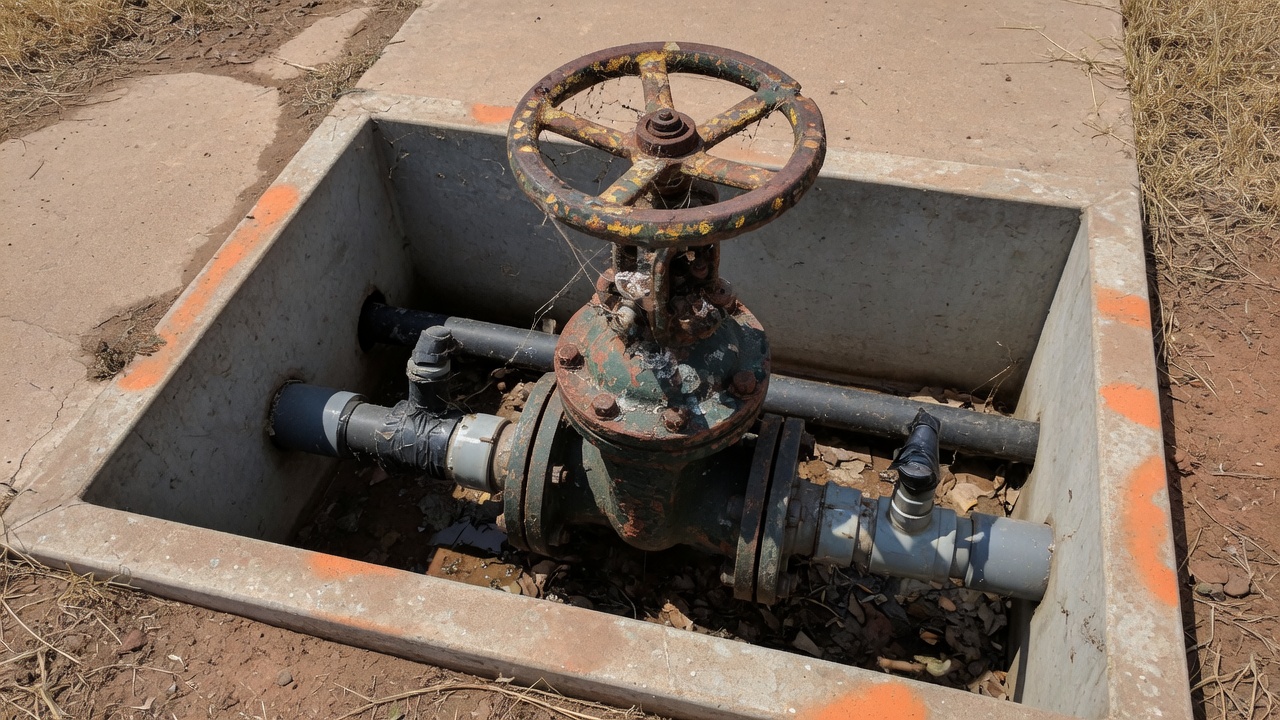
Older Deer Park systems, especially along East Boulevard and Center Street, commonly used a multi-turn brass gate valve in a rectangular box. A gate valve stops water by lowering a wedge into the flow. Leave that wedge half-open for years, add a little scale, and the wedge welds itself to the body. The stem packing gets stiff on top of that. A quarter-turn ball valve fails less often from simple neglect because the ball wipes the seats when it turns, but a ball left untouched for a decade can seize too. The handle shape tells you what you have: a round handwheel usually means multi-turn, a lever usually means quarter-turn. Do not assume the lever’s current position is correct. People leave ball valves halfway, which destroys the seats and still does not shut the water off.
How far to go before you stop
Clear dirt off the stem and the packing nut. Put a penetrating oil on the stem where it enters the packing, not into the waterway, and give it a few minutes. Work the handle back and forth through the small arc it will still travel. You are trying to crack scale, not to finish the close in one pull. If it starts to move, keep the motions short until it travels fully. Then open and close it a few times so the wedge or the ball is not sitting in the same spot.
Stop if the handle jumps, the stem rises without the feel of a wedge moving, the handwheel rounds off, or the box starts to take on water around the packing. A broken stem can leave the wedge dropped in the closed position, or worse, leave you with no way to stop flow. Do not slip a pipe over the handle. Brass handwheels split, and the extra leverage snaps stems that would have survived a replacement scheduled for a calm afternoon. This is ordinary sprinkler repair when you do it before a break. It is a mess when you do it while water is coming up in the lawn.
If it fails during an active leak
When a mainline is blowing and this valve will not close, do not dig toward the meter hoping to find a friendlier handle. Follow a shutoff plan that does not depend on the seized valve, as laid out in emergency mainline break steps. Treat equipment on the utility side of the meter as the city’s. Forcing a curb stop you do not own can break the fitting the whole house depends on, and that repair is not a sprinkler part. If the irrigation valve and any downstream valve are both useless, call for emergency sprinkler repair and say the isolation valve will not turn. Standing there with a bigger wrench is not a third option.
Replace it with something you can turn
A seized gate valve that you managed to close should still be replaced before you trust it again. The next freeze or the next break is a bad time to discover it has stuck in the other direction. The usual replacement is a full-port ball valve, brass or a pressure-rated plastic valve matched to the pipe, installed so the handle has room to swing a quarter turn inside the box. Unions, or a coupling plan that lets the next person cut the valve out, matter more than the logo on the handle. Point the handle so open and closed are obvious. Leave it fully open or fully closed, never halfway.
Support the pipe. A new valve hanging on a PVC joint becomes a lever, and the joint cracks the first time someone turns it from above. Set the box so the handle clears the lid. If the old gate valve is upstream of the backflow, shut the supply only long enough to make the swap, and open the new valve slowly so you do not hammer the assembly. A packing weep on the old valve is the same neglected part, not a second project.
Deer Park conditions: older valves, tight boxes, and salt in the air
A lot of the housing stock near East Boulevard, Center Street, and the older streets off Spencer Highway was irrigated with brass gate valves that have not been exercised in years. Humidity does the packing no favors, and a valve sitting in a box that floods after rain spends its life underwater. That is a different aging pattern than a dry inland climate. The handle looks fine until the day you need it. Newer ball valves in Spencerview and on recent installs fail less from scale and more from being buried, painted shut, or blocked by a lid that cannot open past a sprinkler head.
Clay also means the box shifts. A valve that was reachable five years ago can sit crooked, with the handwheel against the concrete wall, so the last half-turn was never available. Before you call a valve seized, make sure the box itself is not the stop. Dig the lid free, vacuum the sand, and look at the full travel. If the handle hits concrete, reset the box. If the handle hits its own stop and water keeps flowing, the wedge or the ball is no longer sealing, even if it still turns. Those are two repairs. Mixing them up is how people replace a valve that only needed a box, or rebuild a box around a valve that will never shut. The older layouts and what usually fails on them are the focus of older systems along East Boulevard.
Checklist: a shutoff that will not finish a turn
- Confirm this valve feeds irrigation only. The house should keep water when it closes.
- Clear the box so the handle can travel. Concrete is not a seized stem.
- Oil the stem at the packing nut, not the waterway. Work it in short strokes.
- Stop if the stem spins, the wheel rounds off, or water rises around the packing.
- Do not use a cheater pipe, and do not force equipment on the utility side of the meter.
- If a break is active and this valve will not close, shut down by another path and call.
- Replace a freed-but-doubtful gate valve with a full-port ball valve before you trust it.
- Give the new handle a full quarter turn of clearance inside the box.
- Support the pipe. Open the new valve slowly and watch the backflow.
- Exercise the shutoff twice a year so the next emergency is not the first turn in a decade.
Find the valve on a dry day, before you need it. If it will not travel, or it travels and water keeps going, call Deer Park Sprinkler Repair at (281) 764-7088. Say whether it is a round gate-valve wheel or a ball-valve lever, and whether a break is running right now. Replacement is straightforward when the yard is not full of water, and ugly when it is.