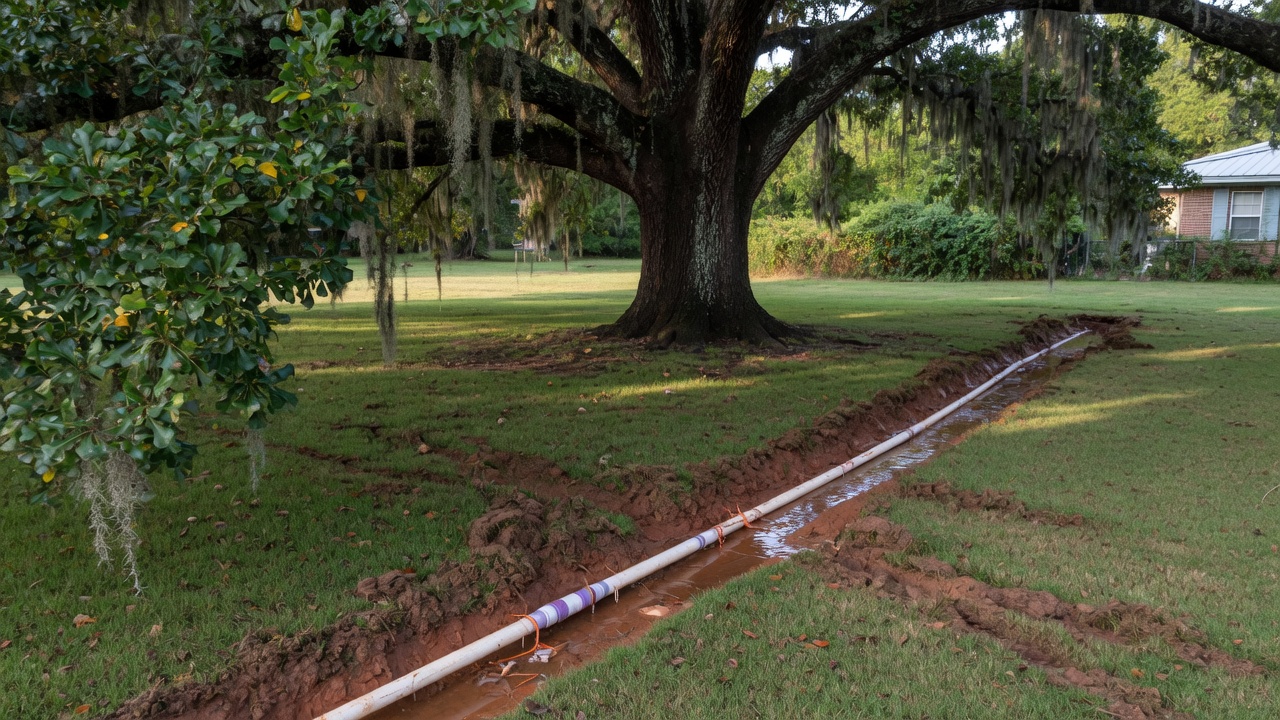
If the wet spot keeps returning under the same water oak, the coupling you glued last summer was never the cause. Water oaks are ordinary trees in Deer Park yards, and their roots run shallow, wide, and straight toward whatever holds moisture. An irrigation lateral is a moisture magnet. The root does not have to pierce the pipe the way roots invade an old sewer. It lifts a joint, flattens poly, or shoves a solvent-weld coupling out of square until a hairline crack opens on the side that lost support. You glue a new coupling in the same trench, backfill over the same root, and the next dry month the crack is back, a foot farther along the drip line.
The decision is whether this leak is a one-time bad joint in open lawn, or a root conflict that will keep winning until the pipe moves. Patching is right only for the first of those.
How a root leak differs from a bad glue joint
A bad glue joint fails at a fitting, once, usually where someone rushed the cement or disturbed the pipe while it was soft. The pipe on both sides lies at the original depth, in a straight line, with no woody root clamped against it. Repair it cleanly, let it cure, and it stays repaired. A root leak shows a root in the trench, a pipe that has been lifted or pushed sideways, a coupling whose two sides no longer share a centerline, or a crack that runs lengthwise where a root pressed from below. The wet soil is oval, not round, and it follows the drip line of the tree more faithfully than it follows the zone map.
If the wet spot sits inside the drip line and the grass shows an old dig, stop buying couplings for the same trench. Heads that lean for no mower reason are telling you the lateral under them has moved too.
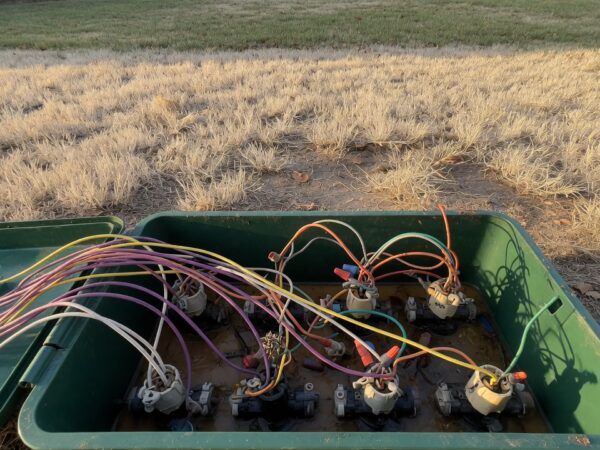
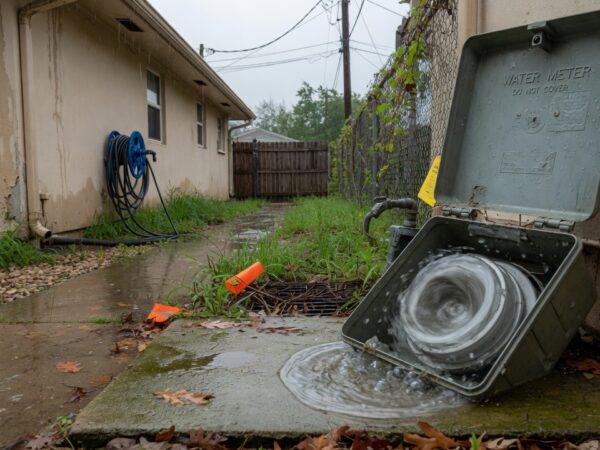
Run the zone and shut it off, then watch the meter. A crack that only weeps while that zone is pressurized is on the lateral. A meter that keeps turning after every zone is off, and after the heads have finished draining, is on the mainline under constant pressure. Roots do not care which pipe they found. A mainline under a water oak is the expensive version because it leaks all day, not only during the program. Treat a moving meter as a mainline leak until you have proved the pressure side is tight. Do not keep capping laterals while the supply pipe is the one the root lifted.
What to do with the pipe, not just the crack
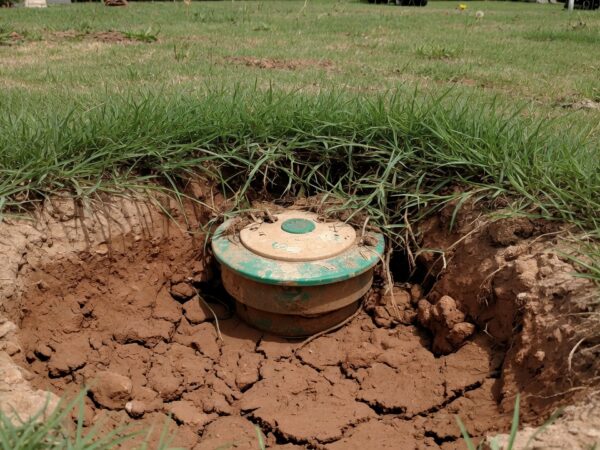
Dig far enough to see the root and the direction of the pipe. If the root is a major flare root at the trunk, do not cut it to save a ten-dollar fitting. Cutting a major root can unbalance the tree and does nothing for the next root behind it. Reroute the lateral out from under the canopy, even if that means two extra fittings and a few more feet of PVC, and move the heads to the edge of the bed where the spray can still reach in. A head parked against the trunk mostly waters bark and mulch.
If one root crosses an otherwise sound run and the pipe must stay, sleeve that short crossing: the working lateral passes through a larger pipe and is not cemented to it. Sleeving is not a strategy for a lateral that wanders the whole bed. Jamming the new pipe against the same root only builds a tighter pinch.
Poly swing pipe at the head is fine. Poly as the whole lateral under a water oak is a pinch waiting. Roots flatten it and the zone just gets weaker until someone thinks the nozzle clogged. If you are already digging, replace that flattened run with PVC outside the worst of the roots, and keep the flexible pipe only for the last foot up to the head. On older yards the existing PVC may already be brittle. A root does not have to be huge to crack pipe that a light freeze and sixty years of sun-warmed shallow trenches have cooked. Those older runs fail the same way on streets like East Boulevard, which is why a repeat leak in old plastic should be read as material plus roots, not as bad luck. The notes on older systems on East Boulevard cover the material half. Under an oak, add rerouting to that advice.
Repair once, or expect a Saturday emergency
A hairline crack on a mainline runs all day, not just during the program. The meter spins and the bed turns into a bog. Know where the shutoff is before you open the hole. If the leak is active and you cannot stop it, that is emergency sprinkler repair, not a project for the next dry weekend.
Let the cement cure before you pressure the line, and keep the new run as far from the trunk as the spray will still reach. Do not pour salt, herbicide, or a root killer into the irrigation. That pipe is connected, through a backflow assembly, to City of Deer Park drinking water. Prune only the small feeder roots already wrapped on the fitting. Cutting a bed full of roots and leaving the pipe in place does not fix the leak.
Deer Park Conditions Under Water Oaks
Gulf humidity and a higher water table on the north side, toward the ship channel and Channelview, keep water oak roots shallow. Clay holds the moisture they are hunting, so they spread instead of diving. A joint that survived spring often lets go in a dry July when the zone runs longest. Occasional freezes crack pipe that roots already lifted into a shallow arch. The freeze gets the blame. The arch was the setup.
St. Augustine under a water oak is already thin, so a leak in that shade looks like a missed head. Cup-test before you add minutes. If the cup fills and the soil is soup, more water will not grow turf in the shade, and it will feed the roots already on the pipe.
Patch, reroute, or emergency shutoff
Patch a single fitting if the pipe is straight, at depth, and no root is bearing on it. Reroute if you have been in this hole before, if the pipe is out of line, or if a root thicker than the pipe is the thing holding it up. Sleeve only a short, unavoidable crossing. Shut the water off and treat it as urgent if the meter turns with the zones off, or if the bed is flooding and the crack is on the pressure side. A new head in the mulch, aimed at the trunk, is not one of the options.
Ordinary sprinkler repair includes leaving the pipe somewhere the tree is not. A coupling in the same cradle as the root is a deposit on the next leak.
Water oak and pipe checklist
- If the wet spot is back under the same tree, assume the last coupling was not the cure.
- Sketch the drip line. Leaks inside that circle get a root inspection, not just a new fitting.
- Watch the meter with the system off. A moving meter means the pressure pipe, not a zone that only runs at dawn.
- Dig until you can see whether a root has lifted, tilted, or flattened the pipe.
- Do not cut a major root at the trunk to save the old alignment.
- Reroute the lateral toward the edge of the canopy and move heads out of the deep shade.
- Sleeve only a short crossing, with the water pipe free inside the sleeve.
- Replace flattened poly laterals under the tree. Keep flexible pipe for the last foot to the head.
- Never put root chemicals in the irrigation line. The other end of that system is the drinking water.
- Find the shutoff before you open a hole you may not finish today.
If the same bed is wet again, or the meter will not stop, call Deer Park Sprinkler Repair at (281) 764-7088. Say the leak is under a water oak and whether you have repaired that spot before. A second repair in the same trench should move the pipe. A third repair in that trench is a choice to keep feeding the roots with your water bill.