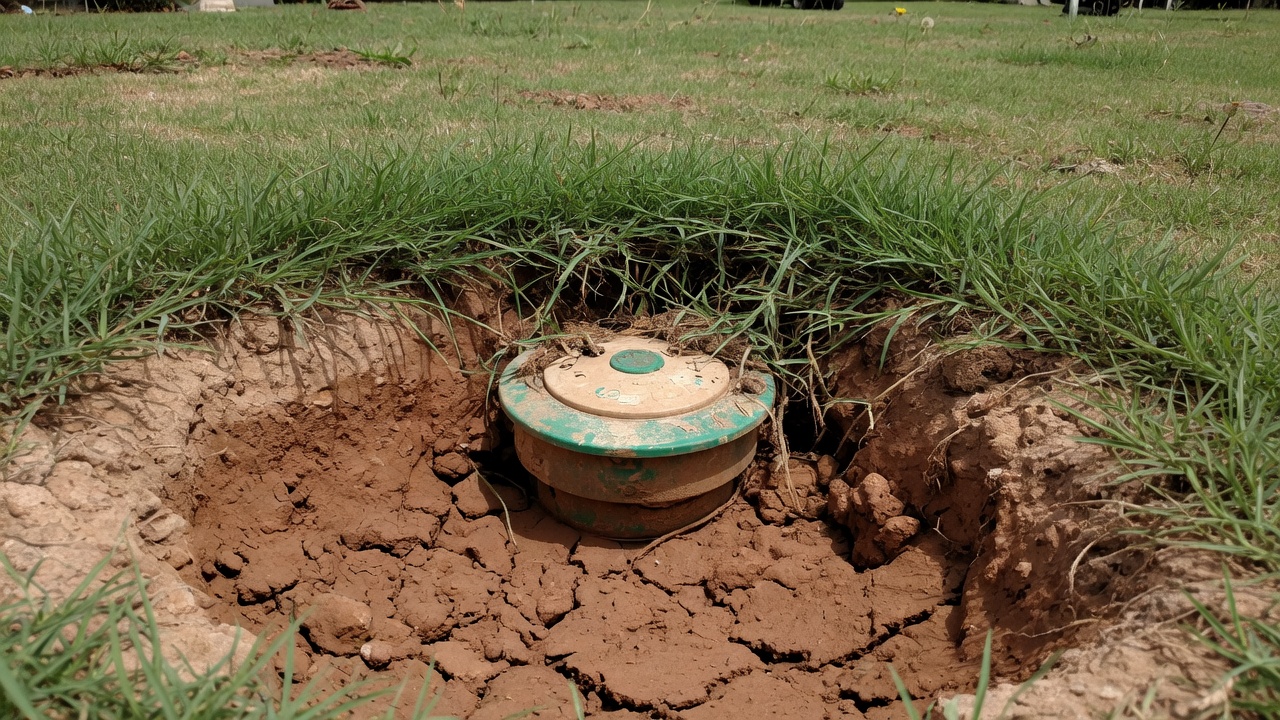
The dry doughnut shows up first. A ring of thirsty St. Augustine sits around a head you can barely see, while the grass four feet out is fine. Someone steps on the spot and the pop-up, which used to stand flush with the lawn, is now an inch under the thatch, spraying into its own hole. In Deer Park that is rarely a mystery part failure. The clay moved, the head stayed with the fitting, and the grade closed over it.
Gulf Coast clay shrinks in a dry month and swells when it is finally watered or rained on. Each cycle lets a rigid head and a short riser settle a little deeper, especially where the trench was backfilled looser than the surrounding yard. Foot traffic, mower wheels, and a low spot that collects water finish the job. By the second summer the nozzle is irrigating soil, not grass, and the puddle reads like a leak.
Sinking is not the same failure as a broken seal
A head that has settled still pops, but the spray hits the wall of the hole and falls as a muddy ring. A head with a failed seal or a cracked body weeps or gushes at the stem, often with a stream that never becomes a pattern. Both waste water. They are not the same repair. Dig carefully. If the body is intact, the nozzle is clear, and the only fault is elevation, you do not need a new brand of sprinkler. You need the head back at finished grade, on a connection that can move the next time the clay does.
If water is running from the head with the zone off, stop treating it as a height problem and sort out a leaking sprinkler head. A valve that will not seat, a torn wiper seal, or grit in the body will keep a low spot wet even after you raise the head, and the extra water is what made the clay soft enough to swallow it.
Deer Park site conditions that pull heads under grade
The movement is worst where the soil was disturbed and then asked to behave like native ground. Older yards along East Boulevard and near Center Street have laterals that were trenched decades ago, repaired in pieces, and then topped with St. Augustine that has built a thick thatch. The head did not have to sink far. The turf grew over it, and a mower deck finished the disguise.
Newer streets in Parkwood and Spencerview often sink at the trench line itself. The pipe ditch settles, the heads on that ditch go with it, and the heads that were bored into undisturbed soil stay put. The result is a wavy zone: three heads at the right height and four sitting in saucers. Raising only the worst one makes the next head the new low point. Look at the whole line before you decide a single extension solved the yard.
Shade near oaks holds moisture longer, so those heads settle in mud while a full-sun parkway head is more likely to heave or to stand proud after the clay shrinks away from it. A wet spring followed by a hard August produces both complaints on the same property: heads too high on the sunny edge, heads buried on the shaded side. Set height when the soil is in a normal condition, not on the day it is either soup or cracked.
Construction along Spencer Highway and the occasional regrade around a new fence do the same thing faster. Fill dirt buries a head that was correct last month. A cut for drainage leaves the head sticking up like a stake, where a mower will break it. Grade changes are head work. They are not something the grass will “grow around.”
The repair that survives the next shrink-swell cycle
Dig out far enough to see the fitting, not just the cap. A head on a rigid riser screwed straight into a tee has no way to flex, so the soil movement snaps the fitting or pulls the head down. A swing joint, or at least a swing pipe with room to move, lets you set the head at grade and gives the clay something to push against besides a brittle thread. Match the thread and the inlet of the head you are keeping. Stacking a chain of cutoff risers to chase a sinking head is how you build a leak under the lawn.
Set spray heads so the top of the body is at finished grade and the pop-up clears the St. Augustine. Rotors need the nozzle above the grass when they are up, which means the body cannot sit in a hole. Tamp the soil back in layers. A head set perfectly in a loose hole will be low again after the first three waterings. If the surrounding grade is the real problem, fix the grade or accept that one head will keep disappearing.
Temporary collar rings can lift a nozzle for a season. They are a patch for a head that is slightly low, not a cure for a lateral that has dropped an inch along twenty feet. If several heads on one zone are low and the coverage is striped, the yard is already on its way to the problem described in uneven coverage after new sod, even when the sod is not new. Height and spacing fail together.
What not to do while the clay is wet
Do not cut heads down during a week of rain because they suddenly look too tall. When that clay shrinks in July they will be below grade again, and you will have thrown away the adjustment. Do not pack a hole with sand and call it drainage. A sand pocket in clay holds a column of water around the head and makes the next settlement worse. Use the soil you took out, minus the rocks and the roots, and do not leave a mound that the mower scalps.
Checklist for a sunk-head walk
- Run one zone at a time in daylight and watch for heads that spray into a hole instead of across the grass.
- Step the pattern. A soft spot around a head often means it has sunk and is mining its own puddle.
- Separate sunken heads from heads that leak with the zone off.
- Check the whole lateral, not only the worst head, before you add extensions.
- Look at fences, new beds, and sod seams for grade that has buried or exposed a line of heads.
- Plan a swing joint where the riser is rigid and the head has sunk more than a half inch.
- Set the top at finished grade so the pop-up clears St. Augustine, then tamp in layers.
- Skip permanent judgments on height during a soaked week or a cracked-clay drought week.
- After the next two irrigations, walk the same heads again. Early settlement shows up fast.
- If a raised head still puddles with the zone off, move on to the valve and the seal.
Maintenance catches this before the lawn rings
A spring or early-summer sprinkler maintenance visit is when sunken heads are cheap. The turf has not yet burned a ring, the soil is workable, and a swing joint can be set before July foot traffic hammers the low spot deeper. Waiting until the doughnut is brown means you are repairing the head and then nursing the grass.
If the rings are already there, the work is still ordinary sprinkler repair, not a new system. Call Deer Park Sprinkler Repair at (281) 764-7088. We raise and reset heads in this clay from the older East Boulevard lots to the trench lines in Parkwood and Spencerview, and we will tell you when the grade, not the nozzle, is what has to change.