A mid-block lot on Center Street has one front walk and one place the wind has to cross. A corner lot has two. There is a second parkway, a side yard the builder often treated as leftover, and a public edge on two sides where overspray is obvious to everyone waiting at the stop sign. The irrigation that came with the house was frequently a rectangular plan dropped onto a lot that is not a simple rectangle. The dry spots and the wet concrete are the plan showing its seams.
Corner lots also drink more water when they are wrong, because there is more edge and more wind, not because the grass is greedier. St. Augustine on the side street bakes against the curb. The back yard, partly sheltered, stays soft. One schedule for both is how the bill rises while the side yard still stripes. The layout has to be designed for the corner you have, which is a different job from copying the neighbor who does not sit on the intersection.
Two frontages change the zone map
Each street edge is a strip of turf with concrete on one side and a sidewalk or driveway cut somewhere in the middle. Those strips want short-radius sprays or side-strip nozzles, spaced so the streams meet along the grass and stop before the curb. A rotor aimed down a parkway will hit cars, walkers, and the street long before it covers the strip evenly. The side yard between the house and the side street is often too narrow for the rotor that was fine in the back. Forcing it onto the back-yard zone ties a fast spray pattern, or a misting compromise, to a slow rotor runtime.
Give the two street edges their own stations when the sun and the wind do not match the back yard. The west-facing side street can need water when the shaded back corner does not. Clay makes the mismatch worse. The sunny edge puddles and then runs to the gutter if you run it long enough to color up the shade. Separate valves let you cycle the hot edge and leave the shade alone. That is more wire and another valve. It is cheaper than a summer of runoff on both curbs.
Head count goes up on a corner even when the lot is not huge. Every outside corner of turf is a place a quarter-circle has to land, and every long edge has to stay head-to-head. Stretching the spacing to “use the heads we have” leaves a crescent that shows from the intersection. The geometry is the same rule as anywhere else, applied to more edges. See head-to-head spacing on a Deer Park lawn before you decide the side yard only needs one head in the middle.
Wind, walks, and the valve that got buried
Corners catch breeze that a mid-block house blocks for itself. Along Center Street, an open intersection lets the afternoon wind bend spray toward whichever curb is downwind that day. Set the arcs in that breeze. A dawn setting that looks perfect will wet the cross street by evening. Pressure that is a little high turns the same heads into mist, and mist on a corner is how both sidewalks go dark while the lawn stays thin. Regulate the spray zones. Do not answer the thin lawn with a longer single cycle that sheets into two gutters.
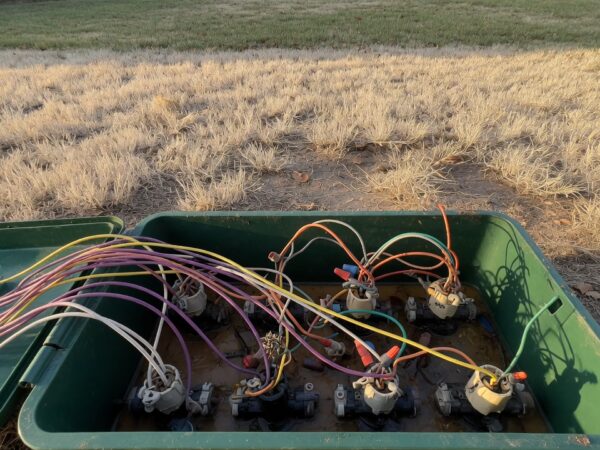
Corner lots also hide hardware in awkward places. The backflow may sit on the side street where it is closer to the meter, exposed to bumps and to the occasional freeze. Valve boxes end up in the side yard that everyone uses as a path, so lids crack and fill with silt. A zone that “always ran” until the lid disappeared under St. Augustine is a common corner-lot call. Mark the boxes before the turf swallows them. Future you, and any tech, will spend the time on nozzles instead of on a probe rod.
Parkways are public-facing and easy to forget. They are still part of the system you pay to run. A broken head in the side parkway dumps water on Center Street every cycle and makes the whole zone look weak. Fix that head before you redesign the back yard around the low pressure it is causing. Neighborhood patterns farther into Parkwood and Spencerview are a different article, Parkwood and Spencerview irrigation patterns, but the corner itself is a geometry problem first.
Deer Park conditions on a Center Street corner
Harris County clay does not care that the lot is prestigious or plain. It takes water slowly on both frontages. St. Augustine on the parkway has a shallow root zone, full sun, and heat off the concrete. It will scorch in the gap between heads while the back yard, a few feet more sheltered, looks fine on the same program. Gulf humidity keeps the sidewalk film wet once overspray starts, so a corner that drifts out of adjustment becomes a slick walk for anyone turning off the side street.
The wider Deer Park grid matters here. Center Street carries traffic, and the breeze that comes across from the direction of Spencer Highway or up from the more open run toward SH-225 has a clear shot at an intersection. You are not imagining that the corner sprays harder than the interior yard you rented before. Occasional freezes hit the exposed backflow on the side street before they hit a faucet under the eaves. After a cold night, look at that device and at any head that now throws a sheet toward the curb. City of Deer Park water rules still apply on both frontages. Watering the gutter on two streets does not become legal because the lot has two addresses’ worth of sidewalk.
Corner-lot checklist
- Walk both street edges while the zones run. Mark every head that wets curb, sidewalk, or street.
- Measure the side yard. If a rotor’s throw is longer than the turf, that edge needs sprays or strips, not a longer rotor.
- Give sunny street edges and shaded back yards different stations when one runtime cannot serve both.
- Check spacing along each parkway. One lonely head in the middle of a long strip will stripe.
- Set arcs in the afternoon wind, not only at dawn.
- Find the backflow on the side street and the valve boxes in the path. Raise or mark lids before they vanish.
- Read pressure on the spray zones. Mist at a corner belongs to pressure regulation, not to more minutes.
- Watch clay runoff into both gutters. Split cycles so the second pass happens after the first drink has soaked in.
- After a freeze, inspect the exposed backflow and any nozzle that suddenly fans onto the walk.
Build the corner you mow, not the rectangle on the old plan
Some corner systems only need nozzles, a straightened head, and a station moved off a shared runtime. That is repair and tuning. Some were piped as if the side street did not exist, and the honest fix is another valve, a strip zone, and heads placed for the edges. That is sprinkler installation even when the back-yard rotors stay. The service area includes these Center Street corners, and the diagnosis starts with the two curbs, not with a generic “add ten minutes.”
Call Deer Park Sprinkler Repair at (281) 764-7088 and say it is a corner lot, which street the dry edge faces, and whether the sidewalk on the side street is getting wet. Those facts sketch the zone map before anyone lifts a shovel. A corner can look as even as a mid-block yard. It just needs a plan that admits it has two fronts.