Parkwood and Spencerview are established Deer Park neighborhoods, and a lot of their irrigation still behaves like a builder layout that never got a second draft. The heads were set when the trees were thin and the beds were small. The St. Augustine filled in, the shade moved, and the same four or six zones kept the program they had on move-in day. The lawn’s complaints are local and repeating: a dry ring past a trunk, a valve box you can no longer find, a side yard that puddles while the front parkway burns.
None of that requires a story about one house. It is the pattern of older Harris County subdivisions on clay, with potable water, a backflow at the edge of the yard, and spray heads asked to do jobs that changed under them. The fix is rarely “new everything.” It is a clear look at what the zones cover now, not what they covered when the fence was new.
What the original layout usually still is
Builder systems in these neighborhoods tend toward spray zones on the front and sides and, where the back yard is deep enough, rotors or a second set of sprays behind the house. The pipe is small, the zone count is tight, and the nozzles were a matched set for about a season. Years of replacements put whatever nozzle was on the truck into a broken head. A quarter-circle corner now flows like a full circle. The front zone runs long enough to save that corner and floods the rest, or it runs short and the corner quits. Matched precipitation was true once. It is often no longer true.
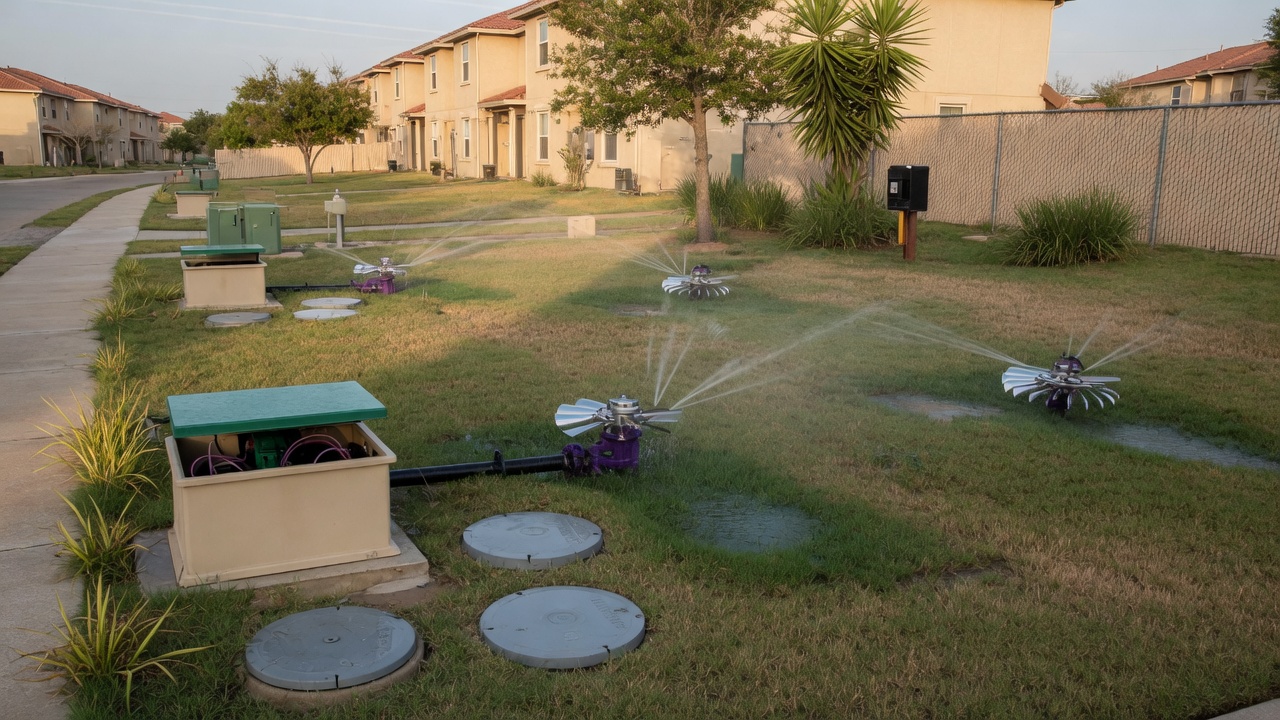
Heads sink. Soil, thatch, and St. Augustine build a lip, and a four-inch pop-up sprays into that lip instead of over it. The pattern looks weak, so the runtime grows. Water puddles on the clay and wanders to the sidewalk along Spencer Highway or the interior streets that feed it. Raising heads to grade, and moving the worst of them to a six-inch pop-up where the turf is thick, gives the nozzle a chance to throw the radius it was bought for. That single change fixes more Parkwood stripes than a new controller does.
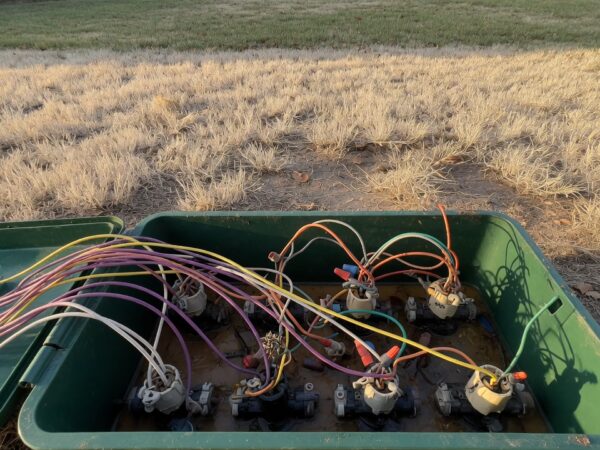
Valve boxes tell the age of the system as honestly as the heads. Lids crack, silt fills the box, and the wires sit in mud. A zone that fails after every hard rain is often a splice in that mud, not a mysterious controller disease. Boxes that have vanished under the lawn are why a simple solenoid swap turns into an hour with a probe. Mark them. The neighborhoods are not short on grass. They are short on visible lids.
Trees, shade, and beds that outgrew the zones
A head that used to clear a sapling now hits bark. Everything past the trunk is irrigated by drip off the tree, which is not a plan. The grass there thins, and the instinct is to add minutes to the whole station. The minutes puddle the sunny part of the same zone. The shaded part, already slower to dry in Gulf humidity, picks up fungus pressure. The right move is to move the head, add a head on the far side of the canopy, or accept that the zone boundary has to change. Shade and sun on one valve will argue forever.
Beds are the other drift. Shrubs planted on a spray zone block the stream and rot at the crown if the spray stays. Those beds want drip, on their own station, with the turf heads given a clear path again. Leaving a shrub in front of a rotor and calling it character is how a back yard in Spencerview ends up with a green shrub and a brown wedge behind it. The same clay that slows turf watering makes a spray aimed at mulch run straight into the grass you were trying to protect.
Corner geometry shows up here too, especially where a street meets a busier cut toward Center Street. Two edges, more wind, more sidewalk. That case is written up in corner lots along Center Street. Interior Parkwood lots skip the second curb and still inherit the tree and nozzle problems. Yards toward the San Jacinto College area share the soil and the humidity even when the streets feel different. The landscape notes for that side of town are in San Jacinto College area lawns.
Deer Park conditions in Parkwood and Spencerview
The soil under both neighborhoods is the same Gulf Coast clay the rest of Deer Park sits on. It accepts water slowly, seals after a heavy rain, and sends surplus to the gutter. Spray zones left at an inch and a half per hour will outrun that soil every summer unless the runtime is split into cycles. St. Augustine is the turf you are usually standing on. It wants a steady weekly depth, on the order of an inch in ordinary weather counting rainfall, and it shows dry crescents fast once the throw is blocked. It also stays wet in deep shade if you water to the sunniest head on the zone.
Wind is milder in a mature canopy than on an open lot by SH-225, until a storm opens a hole or you are standing in the front yard facing Spencer Highway. Front zones still mist onto walks when pressure is high. Occasional freezes still split a head or an exposed backflow, and the first symptom in January is often a zone that fans onto the driveway. City of Deer Park watering rules and the backflow on the potable supply apply on these streets the same as anywhere else in town. A rain sensor stuck in the closed position, or one that was bypassed years ago, is the other neighborhood classic. The canopy drips, the sensor thinks the lawn is watered, or the sensor does nothing and the system runs through a gulf downpour. Both are worth testing before you replace pipe.
Neighborhood system checklist
- Run each zone and count heads that hit trunks, fences, or the sidewalk. Those are redesign points, not timer points.
- Look for mixed nozzles on one station. Put the zone back on one matched family before you judge the runtime.
- Raise sunken heads. Where St. Augustine is tall, a taller pop-up beats a longer schedule.
- Find every valve box. Dig the lid clear, and replace a cracked lid before it becomes a mower blade problem.
- Split sun and shade if one zone cannot dry evenly. Trees that grew up are allowed to change the zone map.
- Move shrub areas toward drip on their own station when sprays are soaking crowns and missing the turf behind them.
- Test the rain sensor with a wet finger or a short forced run. A bypassed sensor is not a sensor.
- After a freeze, check the backflow and any head that changed from a stream to a fan.
- On clay, note when runoff starts and cap each cycle there, in Parkwood and in Spencerview alike.
Repair the pattern, then the parts
A nozzle swap, a raised head, and a sensor that works again will settle a lot of these yards. A lateral crushed by a root, a valve full of silt, or a zone that never had a head past the oak will not. That is sprinkler repair with a neighborhood shape to it: older spray layouts, buried boxes, and shade lines that moved. If you are comparing streets, the service area page is the map. The diagnosis is still the zone in front of you.
Deer Park Sprinkler Repair works these patterns at (281) 764-7088. Say whether you are in Parkwood or Spencerview, which zone goes dry past a tree, and whether a valve box is missing. The grass is not failing because the neighborhood is old. It is failing because the system still thinks the trees are small.