You press the outdoor GFCI reset, walk inside, and it clicks off again before zone one finishes. The app, if you have one, says the controller is gone. The expensive guess is a new timer. The cheap and more common faults are a wet receptacle, a tired GFCI, a failing transformer, or water in the controller’s own 120-volt side. A broken zone wire out in the yard is rarely what a GFCI can even see.
A GFCI watches the current going out on the hot and coming back on the neutral. A few milliamps missing, leaked to ground, and it opens. It is not the breaker that trips when a pump works too hard. That difference decides the whole repair. Chase the 120-volt path first. Leave the lateral wires alone until the outlet will hold a simple load.
What the GFCI can and cannot see
The protection is on the line that feeds the outlet or the controller’s cord. A short between the low-voltage zone wires, a dead solenoid, or a cut common in a bed will blow a controller fuse, open an internal protector, or simply fail that station. Those faults live on the 24-volt side of the transformer. The GFCI does not measure them unless the failure crosses into the primary: a transformer shorted to the chassis, water bridging the 120-volt terminals, a soaked cord, or a plug sitting in a wet box. Replacing zone wire because the GFCI trips is how a Saturday disappears with the outlet still dead.
The other direction matters too. A GFCI that trips with the controller unplugged is not a sprinkler problem. The receptacle, the box, or something else on that same protected circuit is wet or failing. Outdoor outlets in a humid climate do this without any help from a timer. So does a GFCI that has been nuisance-tripping for a year and has finally given up. Test with a dry lamp, not with the controller. Lamp stays on, the fault is in the cord, the transformer, or the controller chassis. Lamp will not stay on, call an electrician for the outlet and leave the timer on the bench.
A safe order of checks
Unplug the controller. Dry your hands. Reset the GFCI. If it will not reset, or it trips empty, stop. Do not bypass it with a plain outlet, a cheater adapter, or a piece of tape holding the reset in. Outdoor receptacles are supposed to be protected, and a controller transformer sitting in the weather is exactly the device that protection is for. If the GFCI holds while unplugged, plug in a dry lamp. If the lamp holds, plug the controller in with the zones not running and watch. A trip the moment the plug goes in points at the cord, the primary of the transformer, or a wet terminal inside the case. A trip only when a zone starts can still be the primary working harder and leaking, but it is also when you look for water in the chassis rather than a solenoid in the yard.
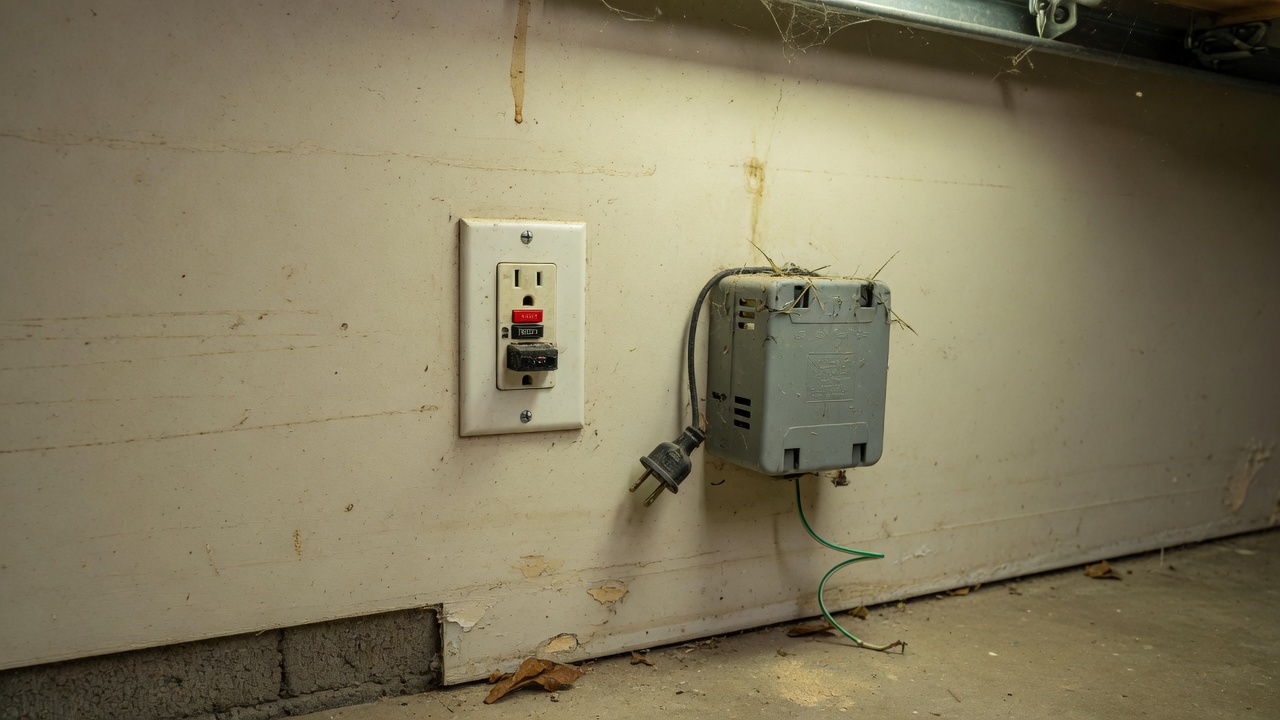
Open the controller only if it is unplugged, and look for the obvious: water stains, ants, a conduit that drained into the cabinet, a transformer that is brown or smells hot, a cord with a cracked jacket. Close it up if you are looking at scorched insulation. That is a replacement, not a cleaning. Plug-in transformers do not belong in a valve box, under mulch, or on an extension cord lying in a bed. Put the controller on a receptacle with an in-use cover, the kind that closes over the cord while it is plugged in. A flat cover that only works when nothing is plugged in is why the outlet fills with rain the first night the system runs. If the same GFCI also feeds a freezer, a pool light, or a garage door, a leak in that other device will take the sprinklers with it. A dedicated outlet for the timer is not a luxury on a circuit that already misbehaves.
Internal transformer or plug-in brick
Some controllers carry the transformer inside the cabinet and are hardwired or plugged in with a short cord. Others use a brick on the plug. A brick that is swollen, buzzing, or too hot to hold is the fault you can replace without condemning the whole panel, if the model allows a proper replacement supply. Do not substitute a random low-voltage adapter with the wrong current rating. A weak supply will chatter valves and look like a wiring fault, which sends the diagnosis into a zone that will not turn on because of wiring when the wiring is fine. If you are unsure whether the panel itself is finished or only the power supply is, the decision is the one in repair or replace the controller. Do not make that call while the GFCI is still tripping, because you cannot tell a dead panel from a panel that has no power.
Deer Park conditions: humidity, storms, and outdoor boxes
Deer Park humidity is enough to corrode an outdoor GFCI that lives without a real cover. Add a Gulf storm, wind-driven rain, and a receptacle on the side of the house that faces the weather, and trips become seasonal. The industrial weather along SH-225 does not spare a cheap plastic cover. After the rain, people reset the device every morning and call it normal. It is not normal. Each trip is leakage. Ignoring it ends with a controller that truly fails, or with someone tempted to remove the protection so the lawn can run.
Clay and standing water raise the odds that a plug-in transformer or a low outlet is actually sitting damp. Yards that hold water after rain, including lower lots, will wet a controller mounted too close to grade or a cord routed through mulch. Lift the equipment. Use the in-use cover. Keep valve-box moisture on the 24-volt side, where it causes its own problems, and keep the 120-volt side dry. Those are separate repairs. Mixing them is how a wet splice in a box gets blamed for a GFCI that was already failing on clear days. If the trip only happens in the wet month and the lamp test fails only then, the outlet box is taking water. That is electrical work, and it should be finished before anyone programs a new seasonal adjust.
Checklist: a GFCI that will not stay reset
- Unplug the controller before you reset. Note whether the GFCI holds with nothing in it.
- If it trips empty, treat it as an outlet or circuit fault. Do not buy a timer yet.
- Test with a dry lamp. A lamp that holds means the fault is in the sprinkler power gear.
- Do not bypass the GFCI, tape the button, or swap in an unprotected outlet.
- Look for a hot, buzzing, or swollen transformer only with the unit unplugged.
- Move any plug-in supply out of valve boxes, mulch, and puddles.
- Use an in-use weatherproof cover so the cord can stay plugged in and covered.
- Take other loads off that GFCI if a freezer or pool gear shares it.
- Only after power stays on should you troubleshoot a single dead zone as a wiring issue.
- Replace the controller when the primary or the chassis is scorched, not merely because the GFCI clicked.
If the outlet will not hold, or the transformer is cooked and you want the panel checked before you buy one, call Deer Park Sprinkler Repair at (281) 764-7088. Say whether a lamp stays on in that same GFCI. You can also start from the contact page. The useful visit is controller repair aimed at the power side, not a new head on a zone that never lost its wire.