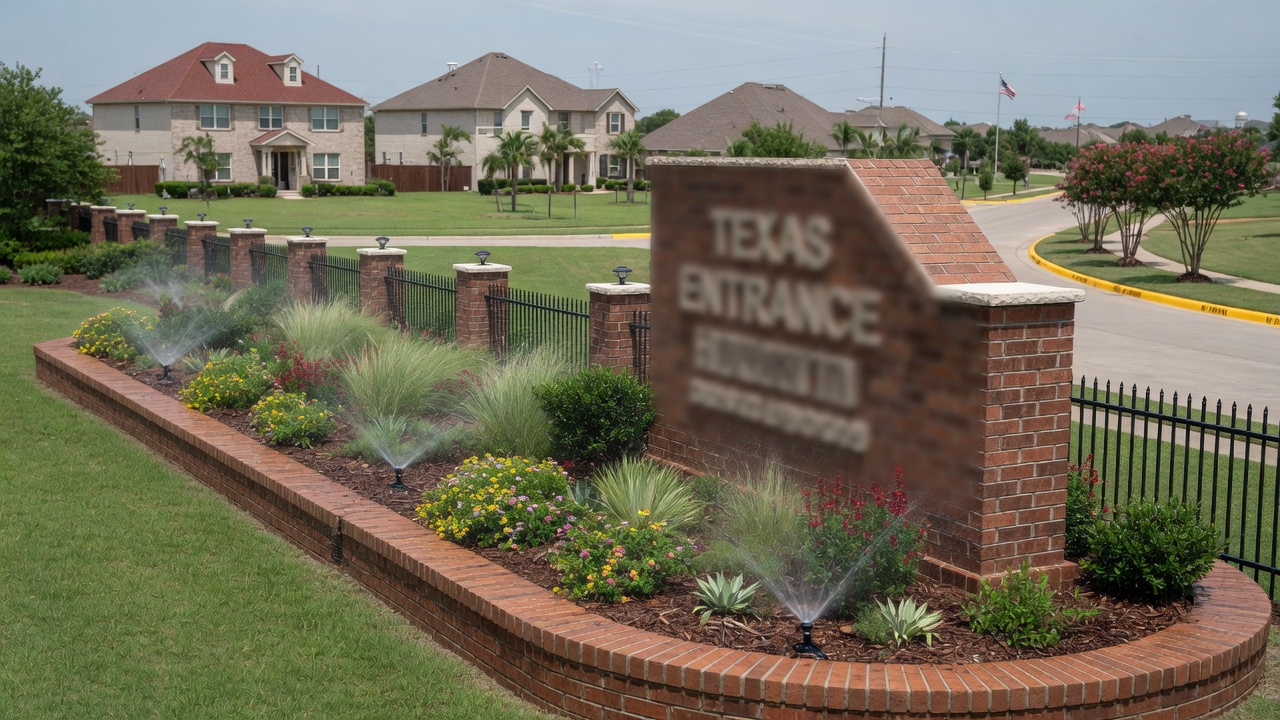
The entrance on a Deer Park subdivision can go brown for two weeks before anyone agrees whose valve it is. Residents assume the city mows and waters the monument. The city assumes the association does. The association’s board has a controller code written on a faded card in a pool-house drawer, and the valve that feeds the boulevard is stuck open in a box the landscaper has been stepping over. Common-area irrigation fails quietly because nobody lives next to the manifold. The water bill and the dead St. Augustine are the first two votes that something mechanical happened.
A common-area system is a small commercial system with residential politics. One meter, often in the association’s name, feeds a backflow and a manifold that may water an entry, a median, a detention-basin edge, and a pocket park. The difference is access, documentation, and the fact that a valve left passing water runs all night on the HOA’s dime.
Who owns the valve is a map question
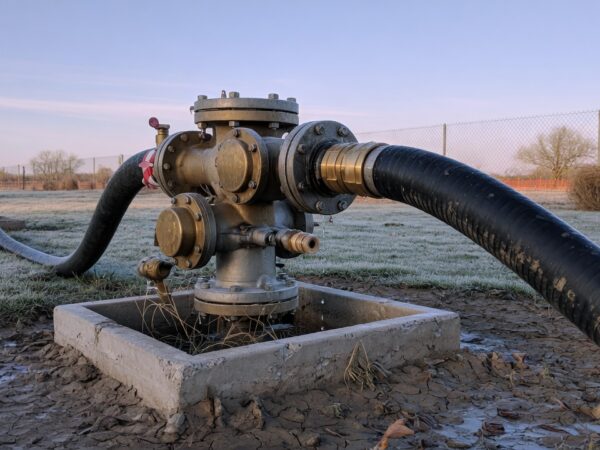
Before anyone replaces a part, the board needs three locations in writing: the meter, the backflow, and the shutoff. If those sit on a city easement or on a lot the developer still owns, the landscaper may not be allowed to dig, and the association may not be the customer of record. If they sit inside the monument planting, they are almost certainly the association’s to maintain. Guessing wrong produces a repair that the city then red-tags, or a leak that runs because everyone was waiting on a department that does not have the account.
Zone maps are not a luxury on these systems. A house has a front yard and a back yard. A subdivision common area has stations that skip from the north monument to a median three blocks in, sharing a wire path nobody has traced since the builder left. Label the controller in language a new board member can use: “east entry turf,” “median oaks,” “park drip,” not “zone 4” with no legend. When a resident calls about a geyser by the playground, the map is the difference between isolating one valve and shutting the entire subdivision irrigation off for a week.
Parkwood and Spencerview are the kind of Deer Park neighborhoods where this layout is common: entrance turf, a long mow strip, and valves tucked where the original sod looked uninterrupted. The detailed version of those subdivision systems is in Parkwood and Spencerview irrigation systems. The board lesson is the same in either place. The valve does not maintain itself because the grass is “just the entrance.”
Deer Park site conditions on common turf
Common-area St. Augustine sits on the same heavy clay as the yards around it, with worse compaction. The soil was a construction road, then a median, then a landscaping bid. Water runs off the crown of a boulevard into the curb, and the center of the turf never gets the inch the controller thinks it applied. Cycle and soak, heads set to the real grade, and nozzles that actually reach head-to-head matter more here than on a small lot near Center Street, because the failed area is public and it is large.
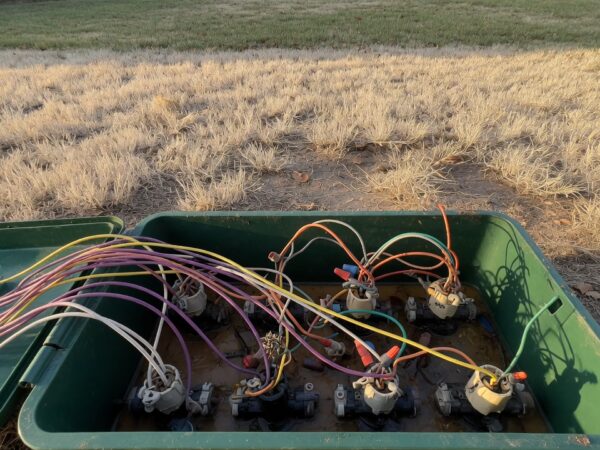
Valve boxes end up at the low side of the monument because that is where the pipe fit. They fill with Gulf rain, the splices corrode, and a solenoid fails closed so the entry does not water, or fails open so the entry is a marsh and the meter spins. A box full of water is not a normal feature of clay. It is either a leak, a low lid in the drainage path, or a valve that has been passing. Annual sprinkler maintenance on a common area should open every box, not just turn the controller on and glance at the color of the grass from a truck.
Wind and reflected heat on a wide entry, especially where the subdivision meets a busier road, mimic the stress of a retail planter. Those entries are still not Spencer Highway commercial sites. A retail pad has customers, a locked electrical room, and a different contract, which is the distinction in commercial irrigation along Spencer Highway. An HOA median has residents, a board budget, and a landscaper who may not be an irrigator. Both need backflow compliance. They do not need the same schedule or the same person holding the only key.
Deer Park’s cross-connection program applies to the association’s meter the same way it applies to a house. An irrigation connection to city water needs an approved backflow assembly. Health-hazard devices are tested when they are installed and once a year after that. Chemical injection, if a vendor ever adds it to the common turf, requires a reduced-pressure principle assembly or an air gap. Miss the test and the city can discontinue the service under its code and TCEQ rules. That is a dried-out entrance plus a reconnection problem, not a paperwork nicety. Keep the test report with the zone map.
Occasional hard freezes hit above-grade backflows at the monument first, because they are in the open and nobody drained them. A January split becomes a March water bill. Put winter shutdown on the same calendar as the backflow test, even though most winters here never ask for it. The year that asks for it is the year the board is surprised.
Valves the board actually has to understand
A common-area manifold often has a master valve or a simple isolation ball valve ahead of the zone valves. Know which is which. Closing the isolation stops a mainline leak. Closing a single zone valve, or capping its solenoid, stops one area from running while the rest of the subdivision still waters. A solenoid replacement or a diaphragm kit is ordinary valve repair and does not require a new controller. A controller that has lost its program after a storm is a separate ticket. Boards get those mixed and approve a full clock replacement when one valve on the median was the wet spot.
Shared wiring is the other surprise. Zones that were added when a pocket park went in may share a common that also serves the entry. Cut that common during a monument remodel and every common-area station dies the same night. Any landscape project that digs near the entry should have the wire path marked first. The association pays either way: in locating time, or in a week of brown turf and an emergency splice.
Checklist a board can hand a vendor
- Write down the meter number, the backflow location, and the irrigation shutoff before the visit.
- Require a zone map with plain-language names and a photo of each valve box.
- Open every box. Note standing water, corroded splices, and valves that hiss with the controller off.
- Run each station while someone walks it. Record heads that hit the street, the monument sign, or the sidewalk.
- Confirm the program fits the current Deer Park drought stage and the account’s watering day.
- File the annual backflow test with the map, and schedule the next one before the tag expires.
- Identify any chemical injection. If it exists, confirm the assembly is reduced-pressure or an air gap.
- List solenoids and diaphragms replaced, by zone, so the next board is not starting from zero.
- Mark wire paths at the monument before any sign, light, or bed project is allowed to dig.
- Set a freeze reminder for the above-grade backflow even if most winters stay mild.
A contract should name the valves
Mowing contracts keep the entrance short. They do not, by themselves, rebuild a diaphragm or pull a stuck solenoid. If the landscaper is not doing irrigation, say so in the scope and hire the valve work separately. If the landscaper is doing irrigation, the scope should include box inspections, a run-through of every zone, and a report when a station will not shut. “The grass looks fine from the car” is how a passing valve becomes a four-figure water bill.
When the monument is mud and the median is dust, call Deer Park Sprinkler Repair at (281) 764-7088. We locate common-area valves, repair the ones that are passing or dead, and leave a map a board can keep, in Parkwood, Spencerview, and the other Deer Park subdivisions where the entrance is nobody’s front yard and everybody’s problem.