The water bill is the first honest witness. A Deer Park yard can look almost normal while a thousand gallons a day leave through a fitting nobody walks past. The second witness is the meter. If the low-flow indicator is turning and every faucet in the house is shut, the water is going somewhere that is not a shower. Before anyone digs, the useful question is whether that somewhere is the mainline, which is under pressure all the time, or a lateral, which should be pressurized only while its zone is running.
The mainline is the pipe from the irrigation shutoff, through the backflow preventer, to the valves. On a typical house it is a constant-pressure line. Open the shutoff and that pipe is full, whether the controller is in rain mode or running zone six. A lateral is everything downstream of a zone valve: the pipe that feeds the heads on that station. It should go soft a minute or two after the valve closes. Those two facts decide where you look, and they decide whether the leak is an emergency or a repair you can schedule.
What each leak does when the clock is idle
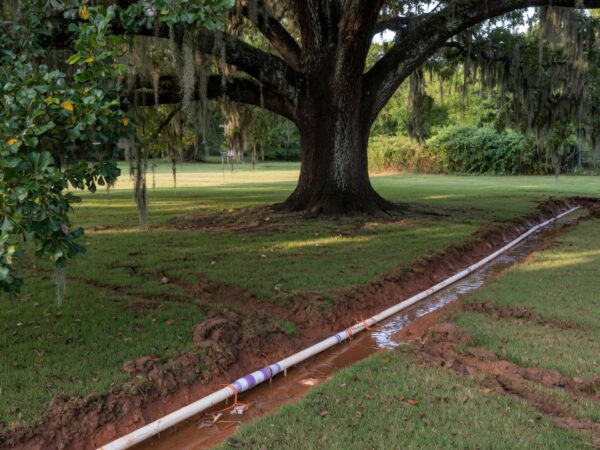
Turn the controller off, or at least make sure no zone is calling. Walk the yard. A wet spot, a sunken patch of St. Augustine, or the sound of water where no head is running is a mainline candidate, a stuck valve, or a plumbing leak that has nothing to do with irrigation. A lateral leak hides in this test. With the valve closed, a cracked lateral fitting is just an empty pipe in the ground. It announces itself only when that zone runs: a geyser at a head, a muddy stripe along the trench, a zone that never builds pressure because the water is leaving before it reaches the last head.
There is one impersonator. A zone valve that does not shut keeps its lateral charged forever, so the yard looks like a mainline leak and the meter looks the same. The difference is location and behavior. The wet spot follows that zone’s pipe, a head on that zone may weep, and closing the bleeder or the flow control on that valve changes the flow. If you have that pattern, read why a Deer Park valve will not shut off before you start digging up pipe that is only a victim. Replacing ten feet of lateral will not stop a diaphragm that has grit on the seat.
Use the meter as a yes-or-no test
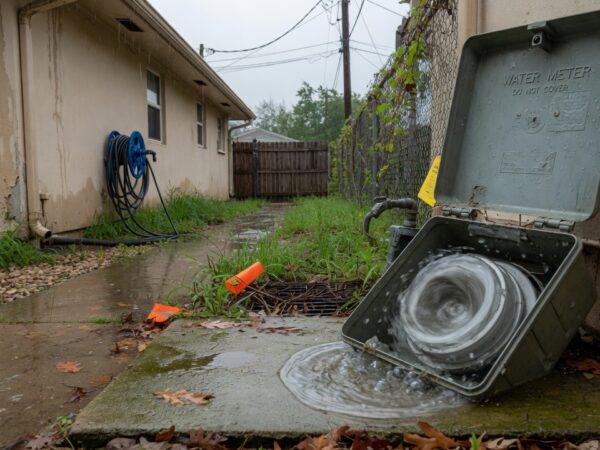
Shut off every water use in the house, including ice makers and irrigation. Watch the meter for several minutes. If the indicator stops, you do not have a continuous leak on the city side of the plumbing. If it keeps moving, the leak is real. Next, close the irrigation shutoff, the ball valve or gate valve that feeds the backflow. If the meter stops, the house plumbing is holding and the irrigation side is where the water was going. Open the irrigation shutoff again with the controller still off. If the meter starts moving, something on the constant-pressure side is open to the soil, or a valve is passing water into a lateral that is itself open.
This test does not find a lateral leak that only exists while a zone runs. For that, run one zone at a time and compare. A zone that throws less water than its neighbors, or that turns the trench into a creek only while it is on, is a lateral. A zone that runs normally while a wet spot near the valve box never dries is still on the mainline side of the story.
City of Deer Park bills the water either way. A jump that shows up the cycle after a hard rain and soil movement is a familiar pattern, and it is laid out in water-bill spikes after a storm. Clay swells, fittings that were barely threaded let go, and the meter does not care that the grass looked fine on the day the bill was estimated.
Deer Park site conditions that hide the wrong pipe
Heavy clay is a good hider and a bad drain. A small mainline leak can travel along the outside of the pipe, or along a sandier trench, and surface twenty feet from the hole. People dig the puddle. The hole is back toward the backflow, often in a straighter line from the meter side of the house to the valve box. On smaller lots near Center Street the mainline is short and the puddle is honest. On deeper lots in Parkwood and Spencerview the mainline may feed a second manifold in the back yard, and the wet ground is halfway down the side fence where nobody thought there was a pressurized pipe.
East Boulevard’s older systems add a second trick. Repairs were made in pieces. A “mainline” that was supposed to be schedule 40 stops being schedule 40 at a coupling installed after a freeze, and that coupling is the leak. Laterals on those yards are often Class 200, which splits lengthwise when a zone is deadheaded against a closed head or when a fitting was overtightened. The split stays quiet until that station runs.
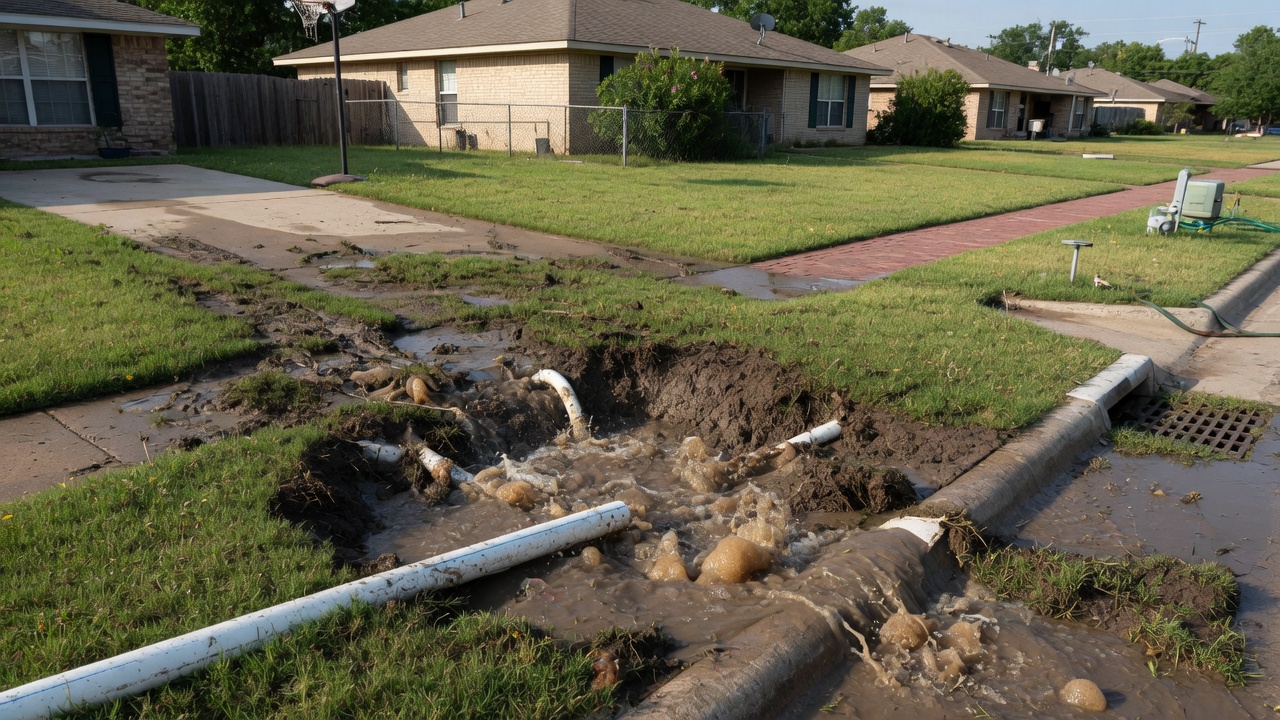
Shade and St. Augustine thatch conceal surface clues. A leak under a dense oak may only show as mushrooms and a soft step, while the same leak in a sunny parkway shows as a sink. Near Spencer Highway and the busier corners, a mainline leak can leave the yard entirely and undermine a sidewalk or a driveway approach. That is no longer a cosmetic wet spot. Water under pavement is how a small fitting becomes a trip hazard and a much larger dig.
Hard freezes crack pipe that was full, especially above grade at the backflow and at any riser that never drained. The leak may wait until the fitting is pressurized in spring. If the meter moved all winter and nobody irrigated, it was never a lateral.
Checklist to sort mainline from lateral
- Turn the controller off and confirm no zone is running before you judge any wet ground.
- Watch the meter with the house quiet. Movement means a continuous loss, not a hunch.
- Close the irrigation shutoff. If the meter stops, the loss is on the irrigation side of that valve.
- Open the shutoff again with the clock still off. Renewed movement points at the mainline or a valve that is passing.
- Find whether one zone’s pipe, and only that pipe, is wet. That pattern is a stuck valve or a lateral charged by one.
- Run each zone alone. A break that only appears then is a lateral on that station.
- Trace puddles back toward the backflow instead of digging only where the water daylighted.
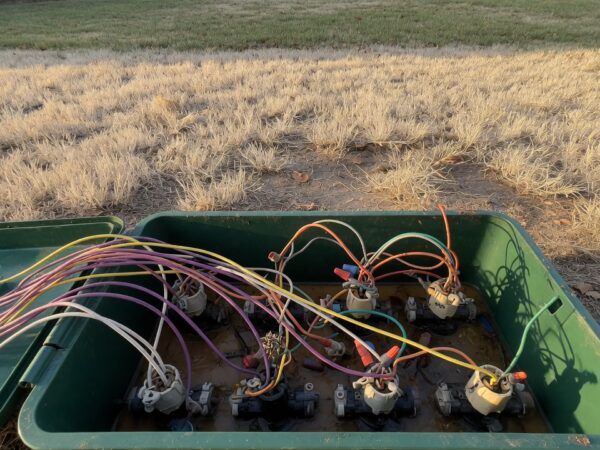
- Listen at the valve box. A hiss with the system off is pressure escaping, not a head problem.
- Note whether the bill jumped after a storm, a freeze, or yard work. The timing marks the fitting.
- If water is surfacing near the slab, the meter, or the sidewalk, treat it as urgent rather than as a weekend project.
When the sort says stop and call
A lateral split on one zone is ordinary sprinkler repair. You can often still use the other zones while that station waits, as long as the valve actually closes. A mainline leak does not offer that choice. It runs until the irrigation shutoff is closed, and closing that valve is the right first move if the puddle is growing, the meter is spinning hard, or water is moving toward the foundation or the street. After that it is emergency sprinkler repair, because the constant-pressure pipe does not heal when the controller is unplugged.
If the meter will not sit still and you cannot tell which pipe is guilty, call Deer Park Sprinkler Repair at (281) 764-7088. We separate mainline leaks from laterals and from valves that only pretend to be leaks, on Deer Park houses and on nearby systems in Pasadena, La Porte, and Channelview.