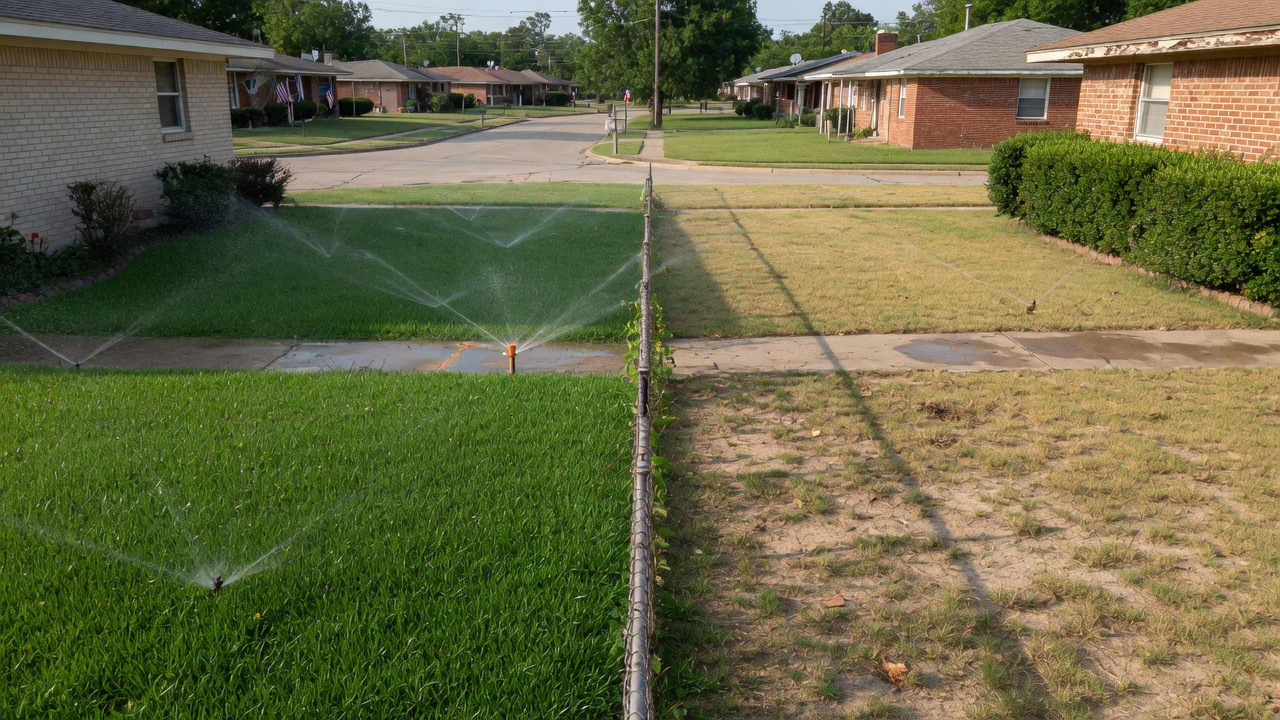
The lawn can sit in Deer Park and still drink from a pressure story that starts on the Pasadena side of the meter. The city line runs along the south and west. Streets feel continuous. Water systems do not. A zone that barely turns the heads over at six in the morning may be starved by the supply, or it may be starved by too much pipe and too many nozzles on an otherwise healthy tap. Those two causes look identical from the sidewalk, and they lead to opposite repairs. Adding a booster, or splitting a zone, on a guess is how border yards end up with a new pump they did not need or a new valve on a street that never had the pressure to begin with.
The diagnostic is a comparison, not a single look at a weak head. You compare the irrigation to a hose bibb at the same hour, the first head on a zone to the last head, and a weekday morning to the early evening when the rest of the block is also watering.
Supply pressure versus zone loss
Open a hose bibb that comes off the house plumbing, not off the irrigation, while the sprinklers are off. If that bibb is strong and steady, the city side is delivering water and the loss is inside the irrigation system. If the bibb is weak at the same moment the heads are weak, you are not going to fix it with a new nozzle. Note the time. Pressure along this border often sags in the evening and recovers before dawn, so a zone that fails at night and looks fine at dawn is a schedule problem. Move it to early morning before you rebuild anything.
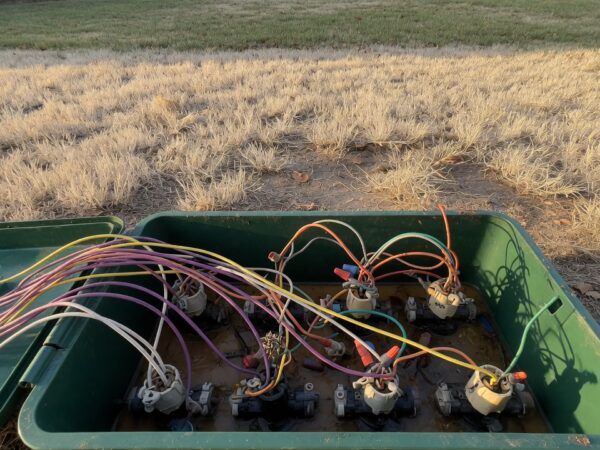
If the bibb is strong and the heads are weak, walk the zone from the valve outward. The first head tells you what the valve is handing the pipe. A first head that sprays a full radius, followed by heads that fade as you walk away, is friction loss: the pipe is too small, too long, or asked to feed too many outlets. A first head that is already misting and soft means the loss happened before the lateral, at a partly closed valve, a clogged filter on the valve, a master valve that is not opening fully, or a backflow that is stuck halfway. Clean and open those before you cut pipe.
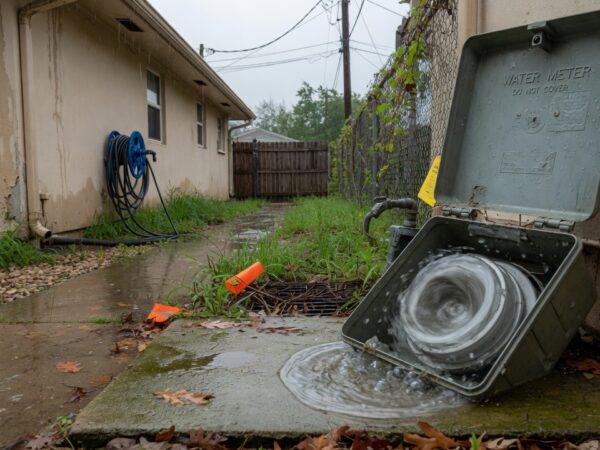
City of Deer Park water reaches the yard through the meter and a backflow assembly. A pressure vacuum breaker or a reduced-pressure device that is full of debris, or a shutoff that was left a quarter-turn from closed after a repair, will flatten every zone the same way. Check that the backflow shutoffs are fully open and that the assembly is not hissing through a relief port. A hissing relief on a reduced-pressure device is a backflow problem, not a Pasadena problem. Fix it before you blame the city line.
The border is not one water system
Deer Park is bounded by Pasadena to the south and west. A neighbor across the line can have a different main, a different peak hour, and a different drought rule. Copying that neighbor’s run times, or assuming their strong rotor zone proves your supply is fine, mixes two utilities. Stay on your own meter. Your test is your bibb, your backflow, and your zones.
If your hose bibb drops on weekday afternoons and is healthy at dawn, run the irrigation when the main is quiet. SH-225 frontage and daytime use along the line can tug on a shared main. A bibb that is weak at dawn too, on more than one day, is the point to ask the utility about supply. A single soft evening is not a trend. A back yard that sits above the valve still costs pressure on its own: compare the first head to the last head with the same gauge. That drop is friction in the pipe, not the city limit under the grass.
When the zone itself is the problem
Count the heads and name their type. Sprays and rotors do not belong together, and a zone that picked up two extra sprays when a bed was added will starve the original heads even if city pressure is excellent. This is the pattern covered in too many heads on one zone: the first heads look almost normal, the last heads fog, and a single-head test looks fine if you cap the others. If a single head, run alone with the rest capped or turned down, suddenly reaches its radius, the supply was never the story. The zone was asking the pipe for more water than the pipe can carry.
Split that zone, or change to lower-flow nozzles and lengthen the runtime so the lawn still gets its inch. Do not “fix” the fade with high-flow nozzles or a booster. Both push more water through a pipe that is already too small.
A zone that is weak at every head, including a single head run alone, with a strong house bibb, points back to the valve, the filter, the wiring that is not fully opening a solenoid, or the backflow. That is ordinary sprinkler repair. A zone that is weak everywhere and the house bibb is weak at the same hour points outside the irrigation system. More detail on reading a soft zone once you know it is on your side of the meter sits in the note on low water pressure on Deer Park zones. Use that after this border test, not instead of it.
Deer Park Conditions Where the Cities Meet
On Harris County clay a soft head and a strong head can look the same for a day, because the soil holds yesterday’s water. Trust the stream in the air and a cup test, not the color of the grass. Gulf humidity lets turf stay green on less water than a dry climate would need, so a weak zone can hide until a hot week along Spencer Highway.
After the occasional hard freeze, a cracked backflow can show up in spring as low pressure on every zone. Look at the assembly before you look at Pasadena. A drought stage that pushes the whole block onto the same evening hours is a clock problem, not a reason to re-pipe a lateral that was fine at dawn.
A decision you can defend
If the bibb is weak only during the neighborhood peak, move the schedule to early morning and stop. If the bibb is always weak, talk to the water provider and do not buy heads. If the bibb is strong, the first head is strong, and the last head is weak, fix the zone layout or the nozzle flow. If the bibb is strong and every head is weak, open the backflow fully, clean the valve, and only then think about pipe size. If one zone is weak and the zone beside it is healthy at the same minute, the supply is innocent. Supplies do not pick a favorite station.
Homes on the Deer Park side of the line are part of the local service area even when the opposite curb is Pasadena. The test does not change at the city limit sign. The utility might. Stay with the meter you pay.
Border pressure checklist
- Test a house hose bibb with the sprinklers off. Strong bibb means the loss is in the irrigation. Weak bibb means look at supply and time of day.
- Confirm both shutoffs on the backflow are fully open and the relief is not dumping water.
- Run the weak zone and compare the first head to the last head with the same gauge or the same cup.
- Run one head alone. If it suddenly reaches full radius, the zone has too many outlets, not a weak main.
- Do not mix sprays and rotors, and do not “solve” a fade by upsizing nozzles.
- If every zone is soft at dawn and the bibb is soft with them, then ask about supply. Not before.
Bring those notes when you call Deer Park Sprinkler Repair at (281) 764-7088. Say whether the hose bibb was strong, and whether the first head matched the last. The repair starts in different places depending on the answer, and the border with Pasadena is not, by itself, an answer.