The blocks around San Jacinto College do not share one watering problem, even when every yard is St. Augustine on the same Harris County clay. San Jacinto College Central sits on Spencer Highway on the Pasadena side of the line, and the Deer Park streets just beyond that campus get class-change foot traffic, evening event parking, and a band of heat coming off the pavement. A brown edge along the sidewalk there is often compacted clay and worn turf, not a missing nozzle. The irrigation system still has to be checked, because a real dry zone hides easily next to a path people actually walk. The useful split is simple: which part of the yard is failing because of how the property is used, and which part is failing because a head, a valve, or a schedule is wrong.
What the campus edge does to turf
Start with the ground, not the controller. Push a long screwdriver into the brown spot and into a green spot a few feet away, on a morning when the system has not run. If the brown soil stops the screwdriver in the top inch and the green soil lets it sink, you are looking at compaction or a crust, not a head that failed to pop up. Spencer Highway reflects heat onto the first row of turf. People cut across the corner from the sidewalk to a driveway. Cars overhang the parkway. Clay packs under that traffic and then sheds water the way a brick patio does. Spray from a healthy head will bead and run to the gutter even while the lawn six feet in, where nobody walks, is soggy.
That runoff fools people into adding minutes. On this clay the extra time floods the sidewalk and leaves the packed edge just as brown. Use shorter cycles with a soak between them, and move a head off the walkway if the water is landing on soil that cannot take it. If the green lawn beside the path is already wet, believe the screwdriver before you believe the timer.
Mixed heads are the real college-area leak
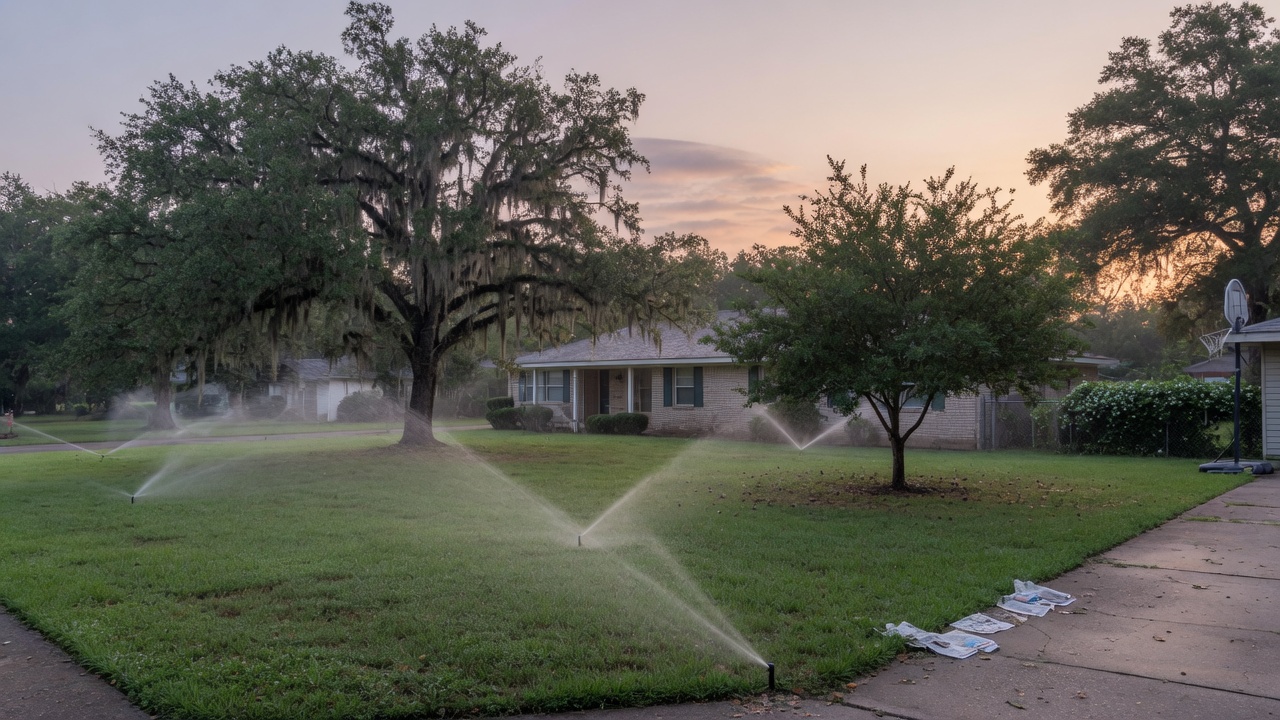
Rental yards along this corridor collect orphan parts. A fixed spray, a rotor, and a rotary nozzle often share one zone because each was replaced the week it broke, by a different person, with no record. Those heads do not put down water at the same speed. A spray can drop an inch and a half an hour. A rotor on the same lateral may drop well under an inch. After fifteen minutes the spray side is puddled and the rotor side is barely dark. The brown patch follows the rotor, and the puddle follows the spray. Nobody did anything exotic. The zone was just never one system.
Walk the zone with the water on and write down the head type at each location before you buy anything. Count how many sprays, how many rotors, and how many nozzles that do not match the arc printed on the top. Look at the thread. A head screwed onto a rigid riser that leans toward the street is a mower hit waiting to happen, and it is also a sign the last repair was done at the surface only. If the pattern is chaotic, the honest repair is to make one zone one precipitation rate, then set the minutes to that rate and to the clay. Sprinkler repair on a mixed zone is mostly subtraction: remove the odd head, do not add a sixth type.
How to test one zone without tearing up the yard
Pick the worst zone and run it by itself in the morning, before the breeze fills in. Set three straight-sided cups in a line: one on the worn parkway, one in the middle of the green lawn, one at the far head. Run ten minutes, not a full program. Measure. If the cups are within a small splash of each other and the parkway cup sits on soil that rejected the water, the heads did their job and the ground did not. If the far cup is nearly empty and you can see a dry wedge behind a tilted head, that head is the job. If every cup is low and the heads sneeze air before they settle, stop and think about pressure and a stuck valve, not about the college traffic.
Check the schedule against the week you are actually having. A program written for a dry August will overwater a humid week when Gulf air never dries the leaves. If the turf is soft, the cups were full, and the brown has a darker rim instead of the shape of a spray pattern, leave the heads alone. More minutes will feed fungus, not fill in the color.
Deer Park Conditions Near San Jacinto College
Clay is the constant. It takes water slowly, seals when it is packed, and holds moisture once it is wet, which is why a compacted parkway and a shaded side yard can fail in opposite directions on the same day. Gulf humidity keeps St. Augustine leaves damp into the morning if the cycle ran at night. Heat along Spencer Highway dries the exposed strip faster than a backyard behind a fence. City of Deer Park water arrives through a meter and a backflow assembly; the campus itself is on the Pasadena side of the line, so a neighbor’s pressure story is not automatically your pressure story. Occasional freezes matter here mostly because rental timers get left in “run” with a cracked head that nobody notices until the first warm week.
Use the neighborhoods that do not sit on this corridor as a comparison, not as a template. A Parkwood or Spencerview system was often laid out as one package, with heads of the same family on each zone. College-area yards were patched. Center Street corner lots share the narrow side-yard problem, but they do not share the foot traffic coming off a campus schedule. Copying either watering program onto a Spencer Highway rental will miss the thing that is actually browning the grass.
What to fix, and what to leave
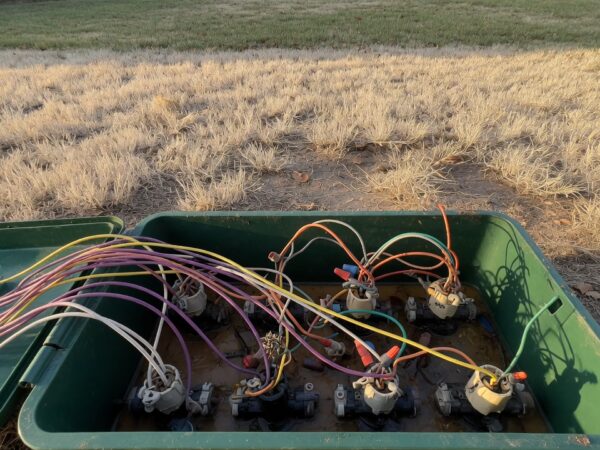
Fix the tilted head, the mixed nozzle, the zone that waters the driveway, and the valve that will not close. Do not redesign the whole yard because the two feet next to the sidewalk are thin. Do not add run time to a spot that is already wet under the shoes. If the cups match and the soil is packed, aeration and a shorter cycle will do more than a new rotor. If the cups do not match, that is sprinkler repair, and it is worth doing before summer locks the clay into a crust. Homes on this side of town are still Deer Park service area even when the campus across Spencer Highway is not. The map of who waters what stops at the meter, not at the college fence.
College-area lawn checklist
- Probe brown soil and green soil with a screwdriver before you change a minute on the timer.
- Run only the weak zone for ten minutes and catch water in three cups: parkway, middle, far head.
- Write down every head type on that zone. Do not leave a spray and a rotor together.
- Watch where people cut the corner and where cars overhang. Do not aim a new head at packed dirt.
- Separate a shaded side yard from a front lawn that faces Spencer Highway if both are always wrong in opposite ways.
- Confirm the meter stops after the zone shuts down and the lowest head has finished draining.
- Skip extra days when the ground is already soft. Humidity will do the rest of the damage for you.
- Compare the layout with a tract yard only after you know this one was patched head by head.
Deer Park Sprinkler Repair covers these streets as part of the local service area, including the blocks between the college corridor and the neighborhoods inside the city. If the cups disagree, or a zone will not shut off, call (281) 764-7088 and describe which head is out of family with the others. Bring the ten-minute test with you. It saves a guess.