In August the mulch along a Deer Park slab can pull back and show a dark gap between the soil and the brick. The St. Augustine three feet away may still be green, because the spray zone is doing its job on the lawn and missing the only soil that actually touches the foundation. Foundation beds are not a decoration hung on the turf clock. On Gulf Coast clay they are a moisture strip with a different rate, a different schedule, and a different piece of equipment.
Clay shrinks when it dries and swells when it rewets. Repeated swings are one of the reasons slab homes in Harris County develop the seasonal movement people blame entirely on the builder. A light, steady wetting of the perimeter beds will not “fix” a foundation, and nobody honest will sell drip as a structural warranty. What drip can do is stop the feast-and-famine pattern a spray head creates: a flood against the brick on watering morning, then a baked bed for three days, then another flood. Even moisture is the goal. Soaked mortar is not.
Two jobs in one planting bed
The shrubs, loropetalum, and seasonal color in a typical bed need water at the root, under the mulch, without wetting the leaves every morning in this humidity. The soil against the grade beam needs enough moisture that it does not separate from the slab during a dry spell. Those jobs overlap, and both of them fail when a lawn nozzle is twisted toward the house.
Spray thrown at the foundation stains brick, rots mulch into a mat, and runs down the soil surface until it finds the weep holes or the sidewalk. The middle of the bed, where the roots are, often stays dry because the pattern never had a chance to soak in. A dedicated drip zone reverses that. Water leaves an emitter at a fraction of a gallon per hour, moves into the clay slowly enough to be absorbed, and never has to fly across a walk.
Emitters, not a soaker hose under a spray valve
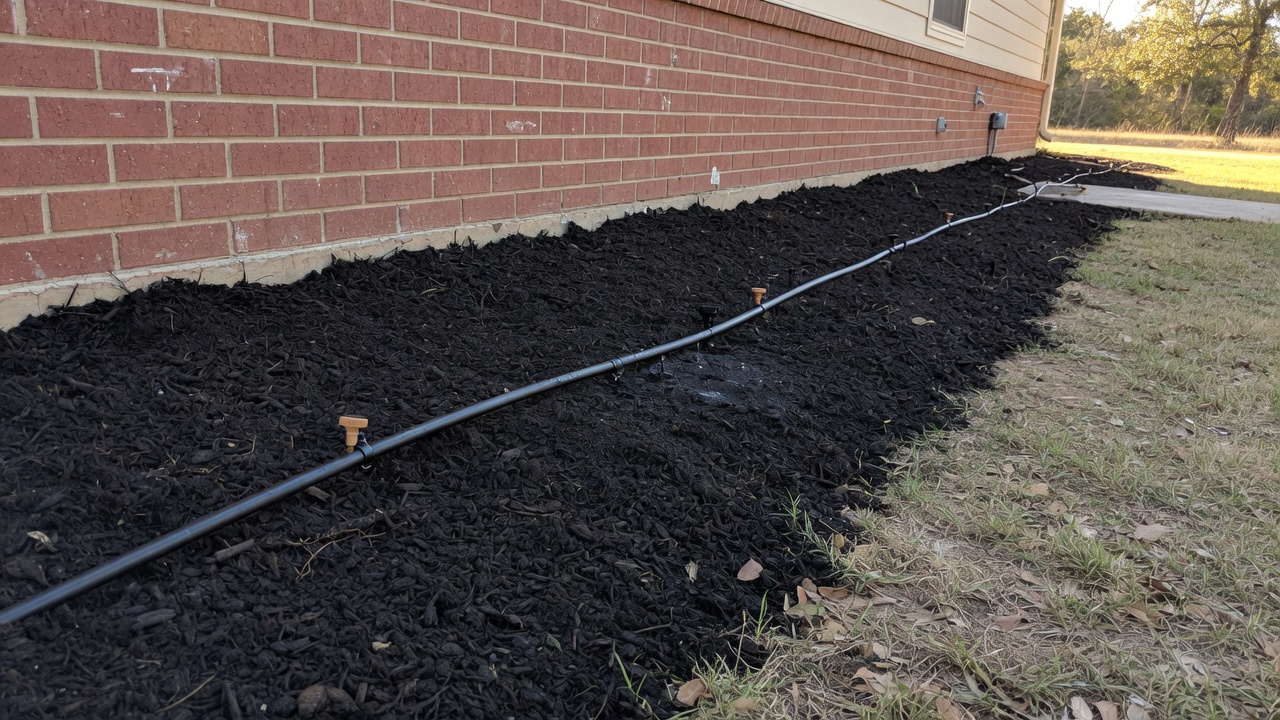
A useful residential layout uses pressure-compensating emitters, commonly in the half-gallon to one-gallon-per-hour range, spaced along the planting and a little closer where the bed is the only thing keeping sun off the slab. Tubing stays on the soil and under the mulch, not buried so deep that a shovel ends the zone on the first planting day. Each line needs a flush end you can find again. A filter and a pressure regulator belong at the head of the zone, because drip parts are built for low pressure and will blow apart or weep at the pressure a spray zone likes.
Run time follows the emitter, not the turf. A one-gallon-per-hour emitter left on for forty-five minutes applies three-quarters of a gallon at that point, not “forty-five minutes of sprinkler.” On Deer Park clay that small dose, repeated on a steady schedule, wets a bulb in the soil without sending water across the patio. If the bed is on the same station as pop-up sprays, you cannot hit both numbers. One of them will always be wrong.
Deer Park site conditions along the slab
Lots near Center Street and along East Boulevard often have narrow side yards. The bed is a foot wide, the fence is the property line, and a spray head has nowhere to throw. Drip is not a style choice there. It is the only way to water the soil without watering the neighbor’s pier or the air-conditioner pad.
Wider front beds in Parkwood and Spencerview look easier and hide a different mistake. The turf rotors stop at the bed edge, the bed itself has no water except rain, and by July the holly is the brown frame around a green lawn. Those beds were frequently “going to be drip later” on the day of the original sprinkler installation, and later never came. Adding the zone now is a retrofit: a new valve, a filter, a regulator, and tubing, not a nozzle twist.
Wind off SH-225 and the open streets near Spencer Highway matters less for drip than for spray, which is the point. Emitters do not drift onto parked cars. What does matter is soil that was backfilled with construction spoil and then covered in rock. Water still has to enter the clay under that rock. If the bed sheds water the way a roof does, the emitter is only wetting the decorative stone. Pull the fabric and the rock back far enough to see the soil take the water before you assume the zone is too short.
Hard freezes are uncommon, but they are real. Above-grade filters, regulators, and the backflow that feeds the whole system need a winter plan. Drip tubing full of water, sitting on top of a bed during a hard freeze, splits at the fittings first. Blow or drain that zone when a real freeze is forecast. Do not discover the leaks in March when you only meant to refresh the mulch.
Why a spray zone keeps losing this argument
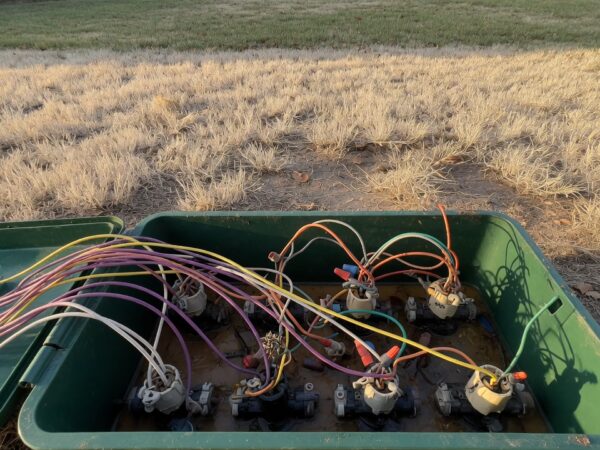
Spray and drip do not belong on one valve. The precipitation rates are not close. A spray head can apply an inch or more per hour. Drip on a bed applies a slow point source. Tie them together and you either flood the bed to save the lawn or starve the lawn to save the bed. The full version of that mismatch is covered in the usual drip-to-spray mistakes, and it shows up constantly on Deer Park retrofits where someone teed drip tubing into a shrub spray because the valve box was already full.
There is a second, local reason to keep them apart. Under Deer Park’s drought contingency plan, drip is often still allowed when spray and hose-end irrigation are limited to a trash-collection day and a midnight-to-10 a.m. and evening window, and drip stays available longer if the city moves into a stricter stage. A mixed zone cannot use that flexibility. You either run the sprays outside the rule or you turn the foundation bed off with them. How the turf side of summer should be scheduled is its own subject in summer watering for St. Augustine. The bed should not inherit that program.
Checklist before the tubing goes down
- Confirm the bed is a separate station from every spray and rotor zone.
- Put a filter and a pressure regulator at the start of the drip zone, not a spray nozzle with the head removed.
- Choose pressure-compensating emitters and space them for the plants and the slab edge, not for looks.
- Leave a flush cap you can reach after the mulch goes back.
- Run the zone and watch the soil, not the mulch, take water before you bury the picture.
- Keep emitters off the brick and out of the weep holes.
- Write the run time down in gallons and hours, and do not copy it from the lawn zones.
- Mark the valve on a map so the next mulch crew does not cut the supply line.
- Check the city’s current drought stage so the drip days you program are actually allowed.
- Plan a freeze drain for tubing and above-grade filters before the first hard cold snap.
Retrofit versus building it with the system
On a new install, the foundation zone is a valve, a wire, and a trench that is already open. On a house that has been spray-only for years, the work is finding a place in the manifold, confirming the controller has a free station, and getting pipe from that valve to the bed without cutting the lateral that feeds the front yard. Either way the parts list is the same: regulated pressure, filtration, emitters sized for clay, and a schedule that is boring on purpose.
If the gap along the slab is already open, or the shrubs are watering the brick every Tuesday, the drip irrigation zone is the repair. Call Deer Park Sprinkler Repair at (281) 764-7088 and we will separate that bed from the lawn zones, from Center Street cottages to the wider lots off Spencer Highway.