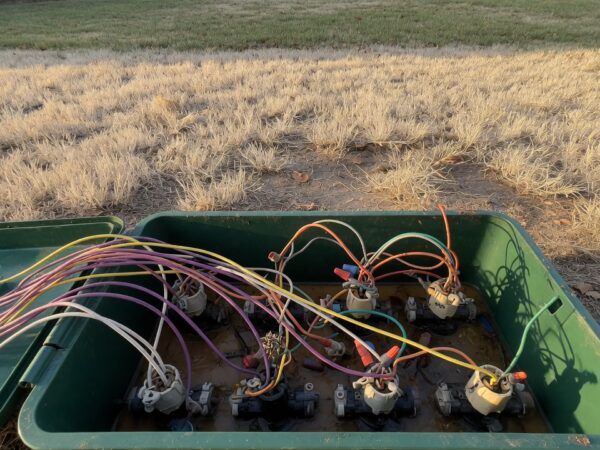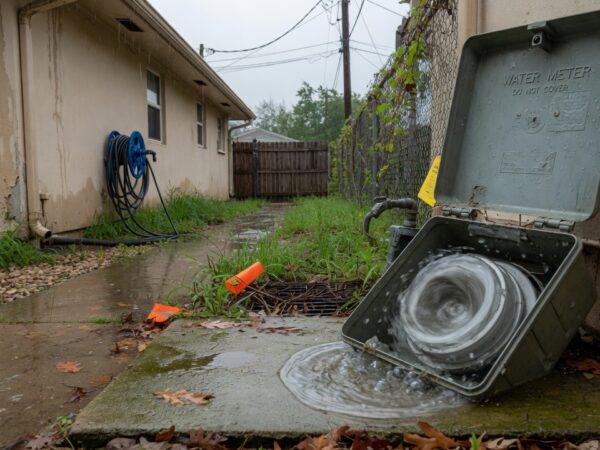
The geyser after a Saturday mow is usually not the nozzle. It is the short pipe under the head, sheared where the mower deck passed. Deer Park lawns are St. Augustine, cut in a thick mat, on clay that shrinks and swells. A head on a rigid riser cannot duck. It sits at whatever height the last person threaded it to, and a deck set for turf will clip whatever plastic or metal stands above that turf. Water then leaves at the crack, not at the spray holes. People replace the head, screw it back onto the same cracked nipple, and meet the geyser again the next time the yard is mowed.
The diagnosis is where the water exits, and whether the head was high, low, or honestly in the path of the deck. Those three scenes are three different repairs.
Where the water is leaving
Turn the zone on only long enough to see the break, or look at it if it is already a fountain and then shut the water off at the controller or the irrigation shutoff. You want one fact: is the spray cap intact while water blows out at the base, or is the cap shattered with water coming from the pop-up itself?
Water from the base, with the body of the head still whole, means the riser, the nipple, or the elbow under the head gave up. The head may be scuffed on the side from the mower and still not be the leak. Unscrew it. A nipple that is split, a funny-pipe barb that pulled out, or an elbow with a crack at the thread is the part to replace. Putting a new head on a split nipple recreates the leak in one watering.
Water from a broken cap, a missing nozzle, or a pop-up that will not seal is the head. That is the case covered under a leaking sprinkler head. The mower can cause that too, by cracking the cap, but the riser underneath may be fine. Do not dig up a lateral because the nozzle took a hit. Do not replace only the nozzle if the threads under the head are what snapped.
A third scene only looks like a mower hit. The head sits in a washed-out hole, and the deck fell in because the soil left. If you see a cavity and muddy water, look for a cracked lateral before you build the head back up on a void.
Why mowers keep finding the same heads
St. Augustine is cut taller than Bermuda, and crews still catch anything proud of the soil. Clay makes that height move. A dry month shrinks the ground and a flush head stands up. A wet month swells the soil or thickens the thatch until a safe head becomes a stump. A rigid riser cannot float with either change.
Swing pipe, the short flexible piece people call funny pipe, lets the head sit at true grade and move an inch when a tire or a deck kisses it. A proper swing joint of short pipe nipples does the same job with more stiffness, which matters on a head that needs to stay aimed. Either one beats a single rigid nipple threaded straight into a tee on the lateral. The rigid stack is what breaks at the thread and what turns a light mower tap into a broken riser. When you repair, rebuild that connection so the head can move. Screwing a new head onto the stub that just failed is how the repair lasts until the following Saturday.
Set the top of the head at soil grade, not at the top of the thatch and not an inch below it. Too high, and the next mow clips it. Too low, and the spray catches grass blades, the pattern collapses, and you have traded a geyser for a brown donut. Low heads on clay are their own failure, the one described in sunk heads in Deer Park clay. A head that was sunk before the mow, and got hit only because the deck fell into the depression, needs the elevation fixed and the soil rebuilt. A head that was proud needs to come down and onto a flexible connection. Same mower, opposite correction.
After the break, before the next cycle
Shut the zone off so a sheared riser does not run the meter all afternoon. A broken riser under pressure wastes more water in an hour than a mis-aimed nozzle wastes in a week, and on a city meter you will see it. Cap or plug the line if a head is completely gone and you cannot repair it before the next scheduled start. Do not leave an open lateral “just for today” if the controller is going to run at dawn and nobody will be outside.
Dig wide enough for a swing joint that does not kink, and replace a steel nipple instead of reusing it. Flush the clay and grass out of the line before the new head goes on, then look at the height from the side. If a mower tire still meets the cap, it is still too high.
Check the other heads along the edge that was just mowed. A white scar on a cap is next week’s geyser. This is ordinary sprinkler repair when the lateral is intact. A sprinkler maintenance visit that runs zones and never looks at head height will miss the ones the crew is about to clip.
Deer Park Conditions That Put Heads in the Blade
Clay shrink and swell is the local mechanic. Gulf humidity pushes St. Augustine so fast that a head set flush in March is buried in thatch by June, or sitting proud on a compacted parkway along Spencer Highway or Center Street. A freeze can tilt a shallow riser, and the mower takes the high shoulder. Wind toward La Porte does not crack threads. City water pressure only makes a split riser a geyser. The cause is mechanical.
Parkway heads between sidewalk and curb get set too high so the spray will clear the concrete. That extra height is what the mower and the string trimmer remove. Set the head at grade and narrow the arc instead.
Riser, head, or sunk body
Choose a new swing connection and the existing head if the body is whole and the leak is at the nipple or the barb. Choose a new head and keep the swing joint if the joint is flexible, unkinked, and the leak is the cap or the seal. Choose a dug-up lateral if the soil has dropped out from under the head and more than the riser is wet. Choose a lower, movable head if the mower keeps hitting the same spot and the pipe underneath is fine. Do not choose a taller riser so the spray “gets over the grass.” Tall is what the mower hit.
After-mowing riser checklist
- Shut the zone off before you shop. An open riser will run until the program ends.
- See where the water leaves. Base of a whole head means riser or nipple. Broken cap means the head.
- Look for a washed-out cavity. A void means a lateral leak, not just a tall head.
- Unscrew the head and inspect the threads it came off. Do not reuse a split nipple.
- Rebuild on funny pipe or a swing joint so the head can move and sit at soil grade.
- Set height to soil, not to the top of the St. Augustine thatch and not an inch below it.
- Flush the dirt out of the line before the new nozzle goes on.
- Check every head along the edge that was just mowed. Scuffs are next week’s breaks.
- Walk the yard after the next mow, before the next dawn cycle, so a fresh shear cannot run all morning.
If the geyser is at the base and the nipple crumbles, or the ground is caving in along the pipe, call Deer Park Sprinkler Repair at (281) 764-7088. Say whether the head body is intact and whether this started the day the lawn was mowed. A broken riser is a small dig when the lateral is sound, and a larger one when the mower only finished what a cracked pipe started.