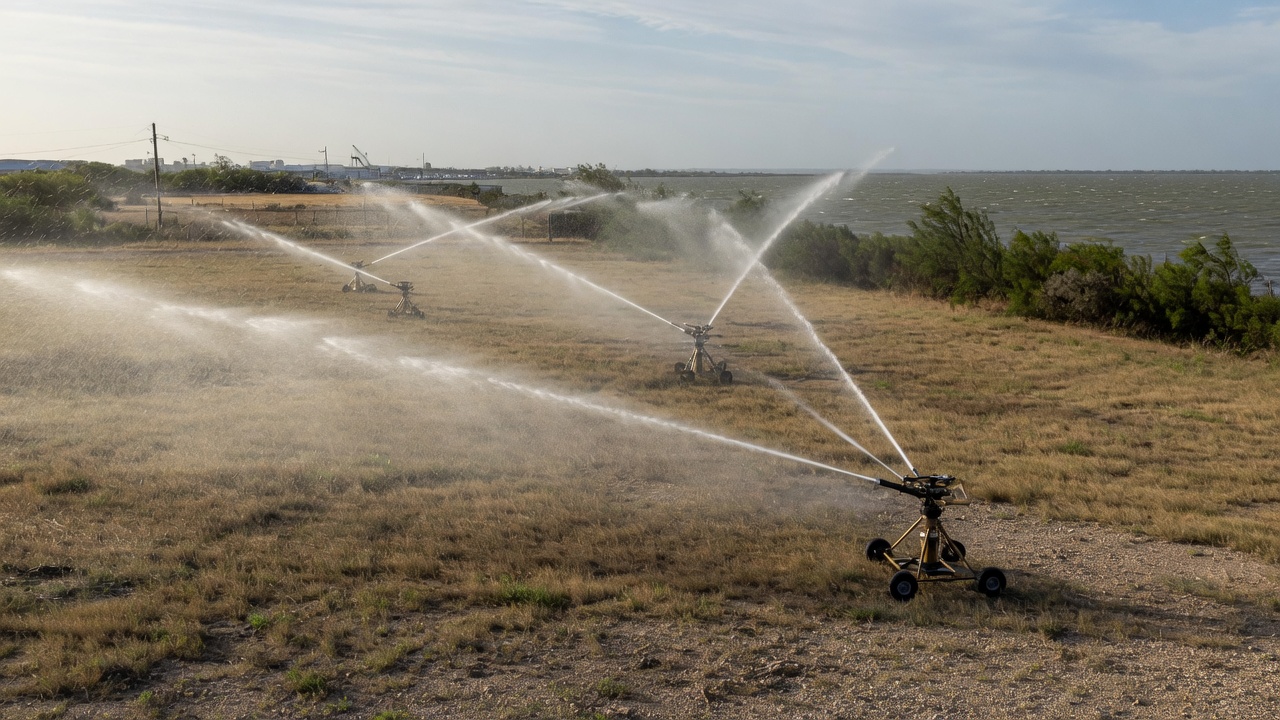
A head that looks perfect at dawn can empty half its water over the fence once the breeze picks up toward La Porte. Deer Park sits between Pasadena and La Porte, open to the ship channel and the Gulf air that follows it. Fixed sprays atomize. Small droplets leave the yard. The grass under the head stays green enough that nobody questions the nozzle, and the neighbor’s fence, the sidewalk, or the street takes the rest. That is not a mysterious pressure failure. It is a droplet-size failure that only shows up when the air is moving. If you adjust the arc at six in the morning on a still day, you will “fix” a pattern the afternoon will undo.
The decision is whether to change when the zone runs, change the nozzle, or actually repair a head that is broken in any weather. Wind is the cause only if the pattern is honest when the air is quiet.
See the wind before you buy parts
Run the zone twice. Once at first light, before the breeze fills in, and once in the afternoon on a day when the flags along SH-225 are standing out toward La Porte. Watch one head, not the whole yard. On the still morning the spray should land where the arc screws say it lands. In the afternoon the same head may bend a fog of water across the east fence and leave a dry wedge on the west side of its circle, the side the wind is coming from. The dry wedge is the giveaway. People water longer to chase it, which only throws more mist over the fence. The soil on the upwind side never catches up, because the extra minutes are not landing there.
Put a cup on the upwind side of the head and a cup downwind, past the grass, on the walk or the bare strip along the fence. Ten minutes is enough. If the downwind cup outside the lawn gets as much water as the cup on the grass, the nozzle is making droplets the wind can steal. If both cups on the grass are short even on the still morning, the head is clogged, the radius is turned down, or the pressure is wrong, and wind is only a guest. Fix the still-air problem first. You cannot tune a breeze if the head is already broken in calm weather.
Look at the plume, not just the wet ground. A nozzle that is sized too small for the pressure hisses and disappears into mist a few feet out. A nozzle with a flake of rust or a seed in one port shoots a needle in one direction and a cloud in the other. Clean it and look again before you replace the head body. A cracked spray head, by contrast, dumps at the cap in both the morning test and the afternoon test. That dump does not care about La Porte. It is sprinkler repair, and no schedule change will make it land in the yard.
Which heads fight wind, and which invite it
Fixed sprays on an edge toward La Porte make a light droplet the breeze can take. They belong in tight parkways only if they run while the air is still and the arc stays off the pavement. A rotor holds a heavier stream, but it throws farther, so a rotor on a ten-foot side yard clears the fence even on a calm day. Do not make that trade.
Multi-stream rotary nozzles sit in the middle. They use the same pop-up body as a spray and put down heavier fingers of water that resist wind better than a fan of mist, at a slower rate the clay can actually take. That slower rate is its own topic, because on Deer Park clay a nozzle that finally stays on the grass can still puddle if you leave the old spray runtime in the controller. The note on rotary nozzles and clay runoff covers that half of the choice. Use it after you know wind, not radius, is the reason the fence is wet. If the problem is simply an arc that was set past the sidewalk on a calm day, fix the arc. The piece on sidewalk overshoot is the still-air version of water leaving the yard. Wind is the version that looks correct at dawn and wrong by dinner.
A dry seam that is already there at dawn will not close because you ran longer in the wind. Extra minutes only move that shortage over the fence.
Set the clock to the air, not to habit
Deer Park mornings are the still window more often than late afternoons, especially when the heating of the day pulls a breeze off the channel and toward La Porte and the bay. Put the zones that face that direction in the earliest cycle. Leave the sheltered backyard, if it is truly sheltered, for later in the program if you have to stagger a limited supply. Do not water those exposed zones at dusk. The wind may have laid down, but wet St. Augustine leaves overnight, in Gulf humidity, are how brown patch gets a start. Early is the compromise that beats both wind and fungus. Midday is the worst of both: wind plus evaporation.
A rain sensor will not skip a dry, breezy afternoon. The fix is the start time, plus a nozzle that still lands water if the breeze arrives early.
Deer Park Conditions on the La Porte Side
The east and south edges of Deer Park, toward La Porte, take more wind than a fenced yard off Center Street. Clay will not absorb a dumped double runtime meant to replace water the breeze already stole. That makeup water runs to the gutter and the upwind seam stays dry. A cracked body from a freeze leaks in calm air too. If the morning test is clean, the freeze is not today’s problem.
When a drought stage limits hours, use the morning half of the window. An evening cycle on a windy east yard wastes water that was legal to use. If every spray fogs on a still morning, the pressure is too high. Regulate it before you blame La Porte.
What to change, in order
First, prove the head is honest in still air. Clean it, set the arc off the pavement, and measure. Second, move the start time into the early morning. Third, if the afternoon test still throws water out of the yard, change to a heavier droplet that fits the spacing, and then cut or stretch the minutes so the clay is not flooded by a slower nozzle left on a spray clock. Fourth, only then move heads that leave a dry seam even at dawn. Skip the rotor-on-a-short-yard idea. Skip the extra evening cycle. Both make the neighbor’s fence wetter and the lawn no greener.
A season of sprinkler maintenance that includes one windy-day walk will catch this. A repair ticket that only replaces the head you happened to see leaking will not.
Wind and nozzle checklist
- Watch the same head at dawn and again on an afternoon when the breeze is toward La Porte.
- Set a cup on the grass upwind and a cup off the lawn downwind. Compare after ten minutes.
- If the still-air test already fails, clean or repair the head before you talk about wind.
- Keep fixed sprays off edges that face the open side of town, or run them only in the still window.
- Do not replace a short spray with a rotor just to “beat the wind.”
- If you switch to a slower multi-stream nozzle, change the minutes. The old spray time will puddle on clay.
- Leave a dry seam that exists at dawn to a spacing fix, not to a longer breeze-time cycle.
- Water exposed zones early. Dusk avoids some wind and invites fungus on St. Augustine.
- If every head fogs in calm air, reduce pressure. The wind is only finishing the job.
If the plume crosses the fence even at dawn, or a head dumps at the cap in both tests, call Deer Park Sprinkler Repair at (281) 764-7088. Say which way the dry wedge faces and whether the morning test was clean. Wind toward La Porte is a real cause. It is not the cause of every wet sidewalk on the east side of town.